

Cosmetic Surgery for Men: How Anatomy Changes the Plan
Published August 1, 2026 · By Dr. Robert J. Troell, Board-Certified Facial Plastic Surgeon
Dr. Robert J. Troell, MD, FACS

Cosmetic Surgery for Men: How Anatomy Changes the Plan
The operations men have are largely the same operations women have — but the anatomy they are performed on, the aesthetic result that counts as success, and the way the tissue heals are all different, and a plan that ignores those differences tends to produce a result that reads as softened rather than refreshed.
That is the practical heart of male cosmetic surgery, and it is rarely what men are told. Most consultations describe the procedure. Fewer describe why the same procedure has to be executed differently on a male face or a male torso to land somewhere a man actually wants to be. Thicker skin over the nose hides fine work. Beard-bearing skin cannot be moved anywhere without consequence. Fat in the male flank and chest behaves more fibrously under a cannula than the fat most technique descriptions assume.
This guide walks through what genuinely differs — structure, aesthetic target, tissue behavior, and healing — procedure area by procedure area, and points to the detailed page for each operation rather than re-explaining it here. It deliberately does not discuss pricing; the cost guides linked below handle that properly.
Considering a Procedure?
Dr. Robert J. Troell offers private consultations to assess candidacy, structure, and what a realistic result looks like for your anatomy.
What Is Actually Different About Male Anatomy
The differences are structural and measurable, not stylistic. They change what a surgeon can do, how visible the work will be, and how the tissue behaves during healing.
A peer-reviewed narrative review of male aesthetic practice describes the male face in concrete terms: men have “a more prominent supraorbital rim, a larger forehead, and flatter cheeks that are more angular,” along with “a more defined hairline with a wider and more forwardly projected chin” (Frucht CS, Ortiz AE. J Clin Aesthet Dermatol. 2016;9(12):33–43. PMID 28210397). The same review notes two facts that matter surgically far more than they matter cosmetically: “Non-facial skin is thicker in males and has a higher collagen content than in females,” and men have “greater vascularity and perfusion of facial skin, which may carry implications for complications… such as bleeding and bruising.”
| Anatomical feature | Why it changes the surgical plan |
|---|---|
| Thicker skin, higher collagen content | Fine sculpting under thick skin is less visible; definition is harder to create and swelling resolves more slowly. Structural change has to be more substantial to show through. |
| Greater vascularity and perfusion | More intraoperative bleeding and more postoperative bruising. Meticulous hemostasis and drainage matter more, not less. |
| Beard-bearing facial skin | Any skin that is repositioned carries its hair follicles with it. Moving hair-bearing skin to a place hair should not grow is a visible, permanent error. |
| Stronger, broader nasal framework | A heavier cartilage and bone framework resists reshaping and needs stronger structural support to hold a change. |
| Prominent supraorbital ridge, deeper-set eyes | The upper-eyelid platform sits differently. Over-resection in this region reads as hollow and unwell rather than rested. |
| Wider, more forwardly projected chin and squarer jaw | Angularity is the aesthetic asset. Softening the lower face is the classic way a male result goes wrong. |
| More fibrous fat, different distribution | Male fat in the flank, upper abdomen, and chest is denser and more fibrous, which changes instrument selection and the energy needed to emulsify it. |
The practice's own procedure dataset is consistent with the pattern. It covers the years 2019 through 2024 and is published in de-identified aggregate form only — each row is a combination of year, procedure category, broad age band, and gender, with no patient-level records and no exact ages or dates. Within that aggregate it reports a meaningful male patient segment concentrated particularly in rhinoplasty and chin augmentation — the two areas where male structure differs most sharply from the template most surgical descriptions are written against. The underlying counts are published on that page rather than summarized here.
The Aesthetic Target Is Different, and That Is the Whole Problem
Most cosmetic surgery is described in the language of softening, smoothing, and refining. Applied literally to a male patient, that language produces the single most common bad outcome in male aesthetic surgery: a face that is unmistakably operated on and no longer reads as male.
The features that a feminizing plan would reduce — a strong dorsal line, a heavy jaw, a projecting chin, a low flat brow line, angular rather than convex cheeks — are in the male face the features that carry masculinity. Removing them is technically easy and aesthetically catastrophic. The result is a man who looks like he has had something done, without anyone being able to name what.
A well-executed male plan is therefore usually subtractive in a different place than a female plan: it removes signs of fatigue and volume loss while leaving structure alone, or it adds structure where structure has been lost. In practice this means preserving dorsal height rather than reducing it, preserving the jawline rather than blurring it, and treating hollowness or laxity without touching the angular landmarks. Stated generally, the principle is that proportion should be assessed against the individual's own skeletal framework rather than against a single ideal — and a surgeon should be able to walk you through that assessment before anyone discusses technique.
This is also why “natural result” means something more specific for men. It is not only that the surgery should be undetectable. It is that the endpoint itself is different, and a surgeon who has not made that distinction explicit before operating is very likely to drift toward the default.
The Male Nose: Thicker Cover, Stronger Frame, Narrower Margin
Male rhinoplasty is the procedure where the anatomical differences bite hardest, and it is the single largest source of male search interest in this practice's own data.
Three things compound. The skin envelope is thicker, so refinement performed on the cartilage underneath is partly absorbed before it reaches the surface. The underlying framework is stronger and broader, so it resists reshaping and springs back against work that is not adequately supported. And the aesthetic target is a straighter, higher dorsum with a less rotated tip — meaning the reductions that would suit a female nose will, applied here, produce a nose that looks feminized and, often, scooped.
Structural support is consequently not an optional refinement in male nasal surgery; it is what makes the result hold. This is the area where Dr. Troell's published work is most directly relevant. His research on alar rim and nasal valve collapse — a structural failure mode that a strong framework and thick skin do not protect against, and that reduction techniques can precipitate — describes a reconstruction technique for exactly this problem (Troell RJ, Powell NB, Riley RW, Li KK. Otolaryngol Head Neck Surg. 2000;122(2):204–211. DOI 10.1016/S0194-5998(00)70240-3), later extended as a transcutaneous alar rim graft technique and as a book chapter in Advanced Aesthetic Rhinoplasty (DOI 10.1007/978-3-642-28053-5_27).
Because the male nasal airway is larger and valve compromise is correspondingly consequential, breathing and appearance are frequently the same conversation rather than two separate ones. Where a structural nasal problem is the primary complaint, that is the subject of functional rhinoplasty, and where nasal obstruction sits alongside disrupted breathing during sleep, obstructive sleep apnea is its own clinical evaluation. The full operation, its candidacy criteria, and what recovery involves are covered on the rhinoplasty page; if you are earlier in the process, what to expect from rhinoplasty walks through the sequence.
Eyelids: Where Men Ask to Look Rested, Not Different
The most common way men describe what they want is that they look tired when they are not. The periorbital region is usually what is producing that impression, and it is also the region where over-correction is least forgiving in a male face.
The male upper eyelid sits under a more prominent supraorbital ridge with a lower, flatter lid platform, and men generally carry less exposed lid show than women. A resection calibrated to a female upper lid, performed here, produces a hollowed and skeletonized upper orbit — which reads not as rested but as unwell. Conservative skin management, and preservation rather than removal of orbital fat where it is doing structural work, are the operative principles.
Dr. Troell published a surgical protocol for this region together with its reported clinical outcomes — a single-surgeon protocol paper rather than a controlled trial (Troell RJ. Peri-Orbital Aesthetic Rejuvenation: Surgical Protocol & Clinical Outcomes. Am J Cosmet Surg. 2017;34(2):81–91. DOI 10.1177/0748806817700534). It is a protocol built around assessing the whole periorbital unit rather than treating skin excess in isolation, which is precisely the assessment a male orbit requires. The procedure itself, upper and lower, is detailed on the blepharoplasty page, and the eyelid surgery recovery timeline covers what the healing period actually looks like.
Facelift in Men: Beard, Blood Supply, and the Sideburn Problem
Facelift surgery in men carries three complications that have nothing to do with the lift itself and everything to do with male tissue: hair-bearing skin, a richer blood supply, and less scar cover.
The first is the one men notice afterward. Male facial skin in front of and below the ear grows beard hair. Any lift redistributes that skin, and if the vectors are not planned around the hair-bearing boundary, beard skin ends up behind the ear or the sideburn is displaced upward and backward into a position that no longer looks like a hairline. It is permanent, it is visible every time the man shaves, and it is a planning error rather than an execution error.
The second is vascular. The greater facial perfusion documented in male patients means more bleeding during dissection and a higher hematoma rate afterward — the reason careful hemostasis and postoperative blood-pressure control carry more weight in a male case (Frucht CS, Ortiz AE. J Clin Aesthet Dermatol. 2016;9(12):33–43. PMID 28210397). The third is simply that men wear their hair shorter and have less tissue to hide an incision in, which constrains where incisions can be placed rather than changing what is done underneath.
Because thicker, heavier male tissue holds less well on a superficial lift, deeper-plane technique is generally the relevant conversation: the facelift page covers the operation, and what the evidence actually shows about deep plane versus SMAS facelifts explains the distinction between lifting skin and repositioning the structural layer beneath it. Where laxity is moderate and the primary problem is skin quality rather than descent, facelift versus skin tightening versus fat grafting sets out the alternatives.
Male Body Contouring: Fibrous Fat and the Flanks
Male fat is distributed differently and behaves differently under an instrument, and both facts change the operation rather than merely the target area.
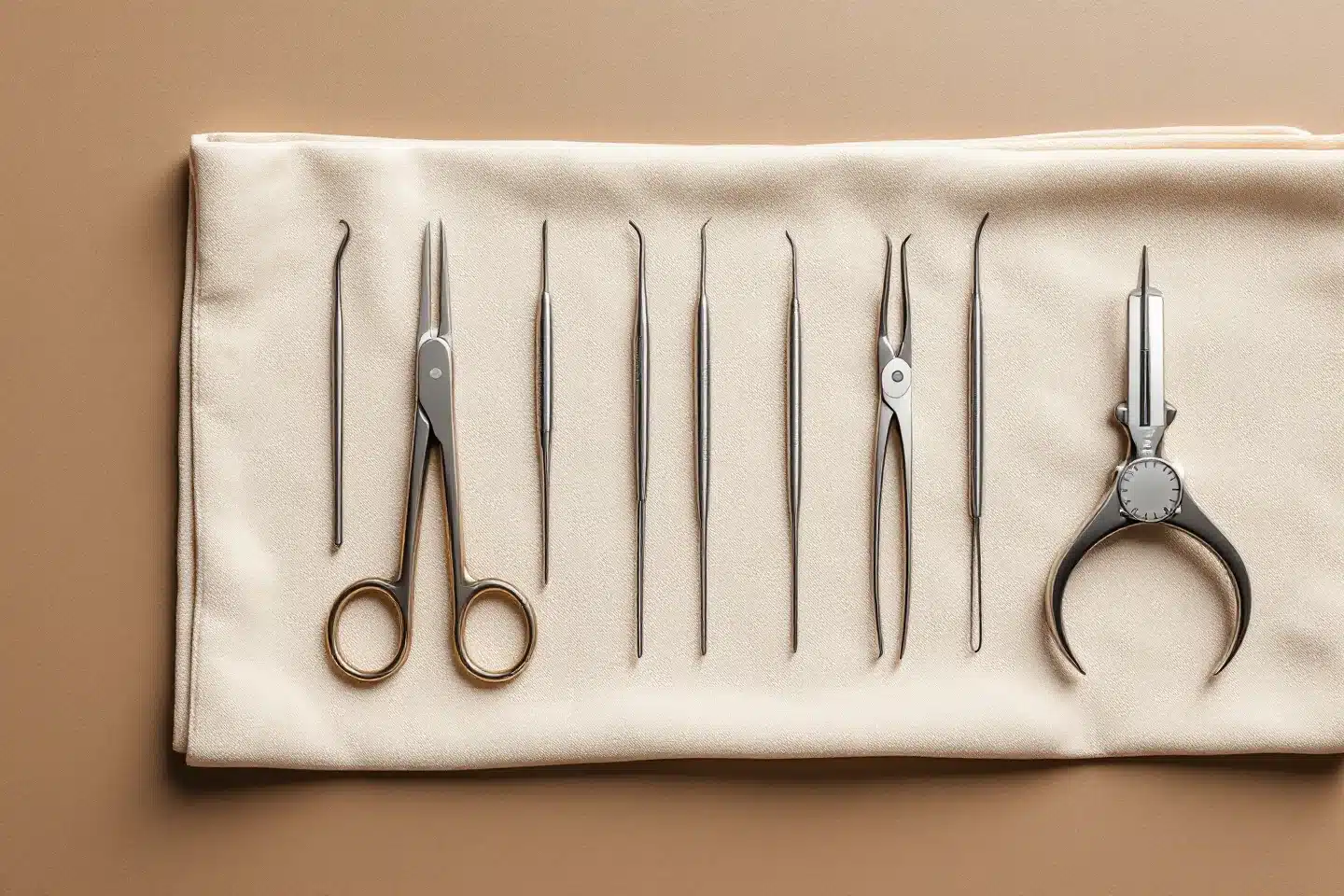
Men typically accumulate fat centrally — flanks, upper abdomen, and chest — rather than in the hips and thighs, and that fat is denser and more fibrous. Fibrous fat does not aspirate cleanly with technique calibrated to softer tissue; it requires more energy to emulsify and is more likely to produce contour irregularity when it is treated as though it were not fibrous. Ultrasound-assisted technique exists substantially because of this class of tissue, which is why third-generation ultrasound liposuction is the usual approach in a male flank or chest rather than an upgrade to it.
Dr. Troell published a two-part account of twenty years of liposuction practice covering exactly this ground — a retrospective single-surgeon clinical experience series, not a randomized comparison — addressing physician qualifications and preoperative risk assessment in Part 1 (Troell RJ. Am J Cosmet Surg. 2026;43(2):178–189. DOI 10.1177/07488068251340106) and optimizing outcomes while minimizing complications in Part 2 (Troell RJ. Am J Cosmet Surg. 2026;43(2):205–222. DOI 10.1177/07488068251352069). Part 2 was subsequently summarized editorially by IFAAS as a set of evidence-based strategies for safer liposuction.
Skin retraction is the second male-specific variable. Thicker skin with higher collagen content retracts differently than thinner skin, and where laxity is present the question of whether tissue will redrape is the question that decides whether liposuction alone is enough. Combining ultrasound liposuction with helium plasma skin tightening was the subject of a further paper (Troell RJ, Javaheri S. Am J Cosmet Surg. 2026;43(2):170–177. DOI 10.1177/07488068251330030). The procedures themselves are covered on the liposuction page and the VASER liposuction page; pricing is handled separately in the VASER lipo 360 cost guide, and the five mistakes people make before lipo 360 covers preparation.
The Male Chest: A Glandular Problem, Not a Weight Problem
Enlarged male breast tissue is the one male concern that is genuinely male-specific rather than a male variant of a shared procedure, and the most useful thing to understand about it is that it is frequently glandular rather than fatty — which is why it does not respond to weight loss.
It is also far more common than most men presenting with it assume. A retrospective, cross-sectional, multicenter study of 237 adult males aged 18 to 85 found the highest prevalence between ages 21 and 30 (n = 74; 31.2%), reported aesthetic concern as the presenting complaint in 62.8% of cases, and — the finding worth sitting with — could identify no cause at all in 45.1%, with anabolic steroid use accounting for 13.9% (Costanzo PR, Pacenza NA, Aszpis SM, et al. Biomed Res Int. 2018;2018:8364824. DOI 10.1155/2018/8364824. PMID 30003107). Nearly half of men with this condition have no identifiable reason for it, which is worth knowing if you have assumed it reflects something you did.
Surgically it matters because glandular tissue must be excised and cannot be aspirated, while any fatty component is contoured — so most cases are a combination, and a plan built on liposuction alone leaves a firm disc behind the nipple that the patient can still feel and often still see. Candidacy, technique, and recovery are covered in full on the gynecomastia surgery page, which is the right place to start if this is your primary concern.
Jaw and Chin: Adding Structure Rather Than Removing It
The lower face is where male aesthetic surgery is most often additive, and where a modest structural change produces a disproportionate improvement in how the whole profile reads.
A chin that under-projects makes the nose read as larger, the neck as fuller, and the jawline as less defined — three complaints that are often presented as three separate problems and frequently resolve as one. Because the male aesthetic favors a wider, more forwardly projected chin and a squarer mandibular angle, augmenting the skeletal base is often a more direct answer than soft-tissue work, and it is durable in a way soft-tissue work is not.
This is also why chin augmentation and rhinoplasty are so commonly planned together in male patients: profile balance is a relationship between the two, and correcting one in isolation can make the other more conspicuous. The specifics are on the chin augmentation page, and the broader range of implantable options across the midface and jaw is on the facial implant page. Where volume loss rather than skeletal deficiency is the problem, facial fat grafting addresses a different mechanism.
Candidacy and Risk: What a Male Consultation Should Cover
Preoperative assessment is not a formality, and there are several items that specifically warrant discussion in a male patient and are easy to leave unsaid.
Dr. Troell devoted the first of his two-part liposuction series entirely to physician qualifications and preoperative risk assessment (Troell RJ. Am J Cosmet Surg. 2026;43(2):178–189. DOI 10.1177/07488068251340106) — a reflection of how much of the outcome is determined before the operation begins. Four items are worth raising directly:
| Item | Why it belongs in a male consultation |
|---|---|
| Anabolic steroid or testosterone use, current or past | Documented in the gynecomastia literature as a leading identifiable cause, and relevant to both the diagnosis and the expected result. It should be asked about plainly and answered plainly. |
| Bruising and bleeding expectations | Greater facial perfusion in men means more visible bruising for longer. This is a planning fact, not a complication, but it determines when you can reasonably be back in front of people. |
| Hair pattern, current and anticipated | Incision placement in facial surgery depends on where hair is now and where the hairline is heading. A plan built on today's hairline can age badly. |
| What “natural” means to you, specifically | The single highest-yield conversation in male aesthetic surgery. Agreeing that structure will be preserved — and naming which structures — prevents the default drift toward a softened result. |
Surgeon selection matters more than technique selection at this stage, and the criteria that apply are not male-specific: how to choose a plastic surgeon sets out what to verify and what to disregard. All procedures at this practice are elective and cash-pay.
Who Wrote This
Dr. Robert J. Troell, MD, FACS is a board-certified facial plastic surgeon and a Diplomate of the American Board of Cosmetic Surgery, with 30 years in practice and 58+ peer-reviewed publications.
The clinical material above is drawn from that published record rather than assembled from general sources — the nasal valve and alar rim work, the peri-orbital surgical protocol, and the two-part liposuction series are his own, and each is cited inline with its DOI above so it can be checked independently. The author record can be verified directly at ORCID 0000-0002-0775-533X and on his Google Scholar profile. The complete record is on the medical publications page, and his training, appointments, and credentials are set out on his surgeon bio.
The practice is located on South Fort Apache Road in the Spring Valley area of Las Vegas, and consultations are in person.
Cosmetic Surgery for Men: Common Questions
Is cosmetic surgery for men different from cosmetic surgery for women?
The operations are largely the same; the anatomy, the aesthetic endpoint, and the healing profile are not. Male skin is thicker with higher collagen content, male facial skin is more vascular, male fat is more fibrous, and the aesthetic goal usually preserves angular structure rather than softening it. A plan that does not account for those four differences tends to produce a feminized result.
What is the most common mistake in male cosmetic surgery?
Applying a softening plan to a male face. Reducing a strong dorsal line, blurring the jaw, or over-resecting the upper eyelid are all technically straightforward and all remove the features that read as masculine. The result is usually described by patients as looking “done” without being able to say what changed.
Why does male rhinoplasty take longer to show its final result?
Thicker nasal skin absorbs swelling and releases it slowly, so the refinement performed on the framework beneath emerges gradually. The stronger underlying cartilage and bone also resist reshaping, which is why structural support techniques matter more in male noses than reduction alone.
Will a facelift move my beard line or sideburns?
It can, and that is the specific thing to plan around. Male facial skin carries beard follicles with it wherever it is repositioned, so lift vectors and incision placement have to respect the hair-bearing boundary. Displaced sideburns and beard skin behind the ear are permanent and visible, and they are planning errors rather than surgical accidents.
Why has my chest not responded to losing weight?
Because it is likely glandular rather than fatty. Glandular breast tissue does not shrink with weight loss and cannot be removed by liposuction — it must be excised. Most cases are a combination of glandular and fatty tissue, which is why treating it as a fat problem alone leaves a firm disc behind the nipple.
Does anabolic steroid use affect candidacy or results?
It is relevant and should be disclosed. In a multicenter study of 237 adult males, anabolic steroid use was the leading identifiable cause of gynecomastia at 13.9%, though no cause at all could be identified in 45.1% of cases. Disclosure affects the diagnosis, the plan, and what result is realistic; it is a clinical question rather than a judgment.
Do men bruise more after facial surgery?
Generally yes. The published literature describes greater vascularity and perfusion of facial skin in men, which carries implications for bleeding and bruising. It is an expected feature of male facial surgery rather than a complication, but it does affect how soon you will look presentable.
Which procedures do men most commonly ask about?
Nasal surgery and chin augmentation are the two areas where male structure differs most from the general template, and this practice's own de-identified dataset reflects a male patient segment concentrated in exactly those two. Chest surgery, eyelid surgery, body contouring of the flanks and upper abdomen, and facial rejuvenation account for most of the remainder.
Evidence & Publications
The clinical claims above draw on Dr. Troell’s published work in nasal structural surgery, peri-orbital rejuvenation, and body contouring, together with external peer-reviewed sources for the general anatomical and epidemiological statements. Each entry is labelled with its study type, because evidence level matters: none of the sources below is a randomized controlled trial, and the male-specific literature in aesthetic surgery consists largely of narrative reviews, protocol papers, and single-surgeon clinical series. The full publication record is on the medical publications page.
- Troell RJ, Powell NB, Riley RW, Li KK. Evaluation of a new procedure for nasal alar rim and valve collapse: nasal alar rim reconstruction. Otolaryngol Head Neck Surg. 2000;122(2):204–211. doi:10.1016/S0194-5998(00)70240-3 Study type: Technique/outcomes study.
- Troell RJ. Nasal Alar Rim Reconstruction for Nasal Rim and Valve Collapse. In: Advanced Aesthetic Rhinoplasty. Springer Berlin Heidelberg; 2013:373–386. doi:10.1007/978-3-642-28053-5_27 Study type: Book chapter (peer-reviewed text).
- Troell RJ. Peri-Orbital Aesthetic Rejuvenation: Surgical Protocol & Clinical Outcomes. Am J Cosmet Surg. 2017;34(2):81–91. doi:10.1177/0748806817700534 Study type: Single-surgeon protocol paper with reported outcomes.
- Troell RJ. Liposuction 20-Year Learned Experience (Part 1): Physician Qualifications, Preoperative Risk Assessment. Am J Cosmet Surg. 2026;43(2):178–189. doi:10.1177/07488068251340106 Study type: Retrospective single-surgeon clinical experience series.
- Troell RJ. Liposuction 20-Year Learned Experience (Part 2): Optimizing Cosmetic Outcomes While Minimizing Complications. Am J Cosmet Surg. 2026;43(2):205–222. doi:10.1177/07488068251352069 Study type: Retrospective single-surgeon clinical experience series.
- Troell RJ, Javaheri S. Combining Third-Generation Ultrasound Liposuction With Helium-Based Plasma Technology Skin Tightening in the Face and Neck. Am J Cosmet Surg. 2026;43(2):170–177. doi:10.1177/07488068251330030 Study type: Combined-modality clinical series.
- Frucht CS, Ortiz AE. Nonsurgical cosmetic procedures for men: trends and technique considerations. J Clin Aesthet Dermatol. 2016;9(12):33–43. PMID: 28210397 Study type: Narrative review.
- Costanzo PR, Pacenza NA, Aszpis SM, et al. Clinical and etiological aspects of gynecomastia in adult males: a multicenter study. Biomed Res Int. 2018;2018:8364824. doi:10.1155/2018/8364824. PMID: 30003107 Study type: Retrospective, cross-sectional, multicenter study (n = 237).

Begin Your Journey with Dr. Troell
Schedule a complimentary consultation with Dr. Troell to discuss your goals, explore your options, and receive an honest, expert assessment. No obligation, no pressure.
Mon–Fri, 8:30 AM – 5:00 PM