

What to Expect from Rhinoplasty: Before, During & After, From the Surgeon
Published May 1, 2025 · By Dr. Robert J. Troell, Board-Certified Facial Plastic Surgeon
Dr. Robert J. Troell, MD, FACS

The short answer: A rhinoplasty is planned around your whole face, not just your nose. Most patients have it under in-office sedation (not general anesthesia), the surgery itself takes about 1.5–2.5 hours, and recovery is more comfortable than people expect — most take pain medication for only a day or two, breathe through the nose almost immediately, and wear a small splint that comes off in 5–7 days. The nasal bridge settles within months; the tip keeps refining for up to a year or two. Below: exactly what happens before, during, and after, from a surgeon who has performed rhinoplasty for 30 years.
The nose sits at the center of the face, so a small change to it changes how the whole face reads. That is also why rhinoplasty is one of the most demanding operations in facial plastic surgery: the goal is never just "smaller" or "straighter," but a nose that looks balanced and natural on your face — and, very often, one that works better too. Rhinoplasty can improve how the nose looks and how well you breathe, frequently in the same operation.
This guide walks through the rhinoplasty journey the way a patient actually experiences it — planning, surgery, and recovery — drawing on the practice of Dr. Robert J. Troell, MD, FACS, a Diplomate of the American Board of Facial Plastic and Reconstructive Surgery and of the American Board of Cosmetic Surgery, who has performed nasal surgery for three decades and has published peer-reviewed work on nasal reconstruction techniques that surgeons use today (his nasal alar-rim reconstruction and radiofrequency turbinate reduction studies, both in Otolaryngology–Head and Neck Surgery). Rhinoplasty was among the most-performed facial cosmetic surgical procedures in the U.S. in 2023, with the American Society of Plastic Surgeons reporting a 6% year-over-year increase (ASPS, 2023).
What this article covers: how a rhinoplasty is planned (including photo morphing and anesthesia choice) · what happens step by step during surgery · what recovery actually feels like · procedures commonly combined with rhinoplasty · what results look like · national cost ranges · the published evidence behind the techniques · FAQ. Considering surgery in Nevada? See the Las Vegas rhinoplasty procedure page for candidacy, local pricing, and booking.
How a Rhinoplasty Is Planned Before You Ever Reach the Operating Room
A natural result is designed long before surgery day. The first visit is mostly listening: what bothers you, what you want the nose to do, and what "looks like me" means for you. From there, the surgeon examines the nose — skin thickness, the strength and shape of the cartilage, the bridge, the tip, and the airway inside — and builds a step-by-step plan tailored to your anatomy.
In Dr. Troell’s words from a patient consultation video:
“It’s what you as the patient want. I’ll give my recommendation on what I think aesthetically is the best… Do you want tip work? A certain rotation? Narrowing? Do you want the bridge taken down? All of those considerations are worked out during your aesthetic consultation.” — Dr. Robert J. Troell, MD, FACS
Different patients arrive with different goals, and the anatomy differs by background. Common concerns include a bulbous or drooping tip, a dorsal hump, or a wide bridge; a flatter, under-projected tip and a wider nasal base; or a low bridge, a short nose, and a wide tip. Good rhinoplasty is ethnically sensitive — the aim is to refine the nose while preserving the features that make a face look like itself, never to impose a single "ideal" shape.
Photo morphing: seeing the result before surgery
One of the most useful planning tools is digital photo morphing. A profile photograph is adjusted on screen — from subtle to more significant changes — so you can see a proposed "after" and confirm the look you want before anything is done. It also reveals how the face works as a whole. As Dr. Troell explains:
“We take a photograph from a side view and change it with a software program so you can see what the end result will be… Morphing also helps determine if you need a chin implant — augmenting a small chin often makes a large nose look significantly smaller.” — Dr. Troell
Anesthesia: why most patients stay out of the operating room
Rhinoplasty does not have to mean general anesthesia. There are two options:
| Option | How it works | Best for |
|---|---|---|
| Sedation anesthesia | Oral sedation + IV sedation + nerve blocks + local anesthesia, performed in the office surgical suite | Most patients — lowest risk, comfortable, less costly |
| General anesthesia | Fully asleep, performed at a surgery center | Patients who prefer to be completely unconscious |
About 95% of Dr. Troell’s rhinoplasty patients choose sedation. Numbing the nose takes only 30–45 seconds; most patients doze off, feel little to nothing, and remember little of the procedure afterward.
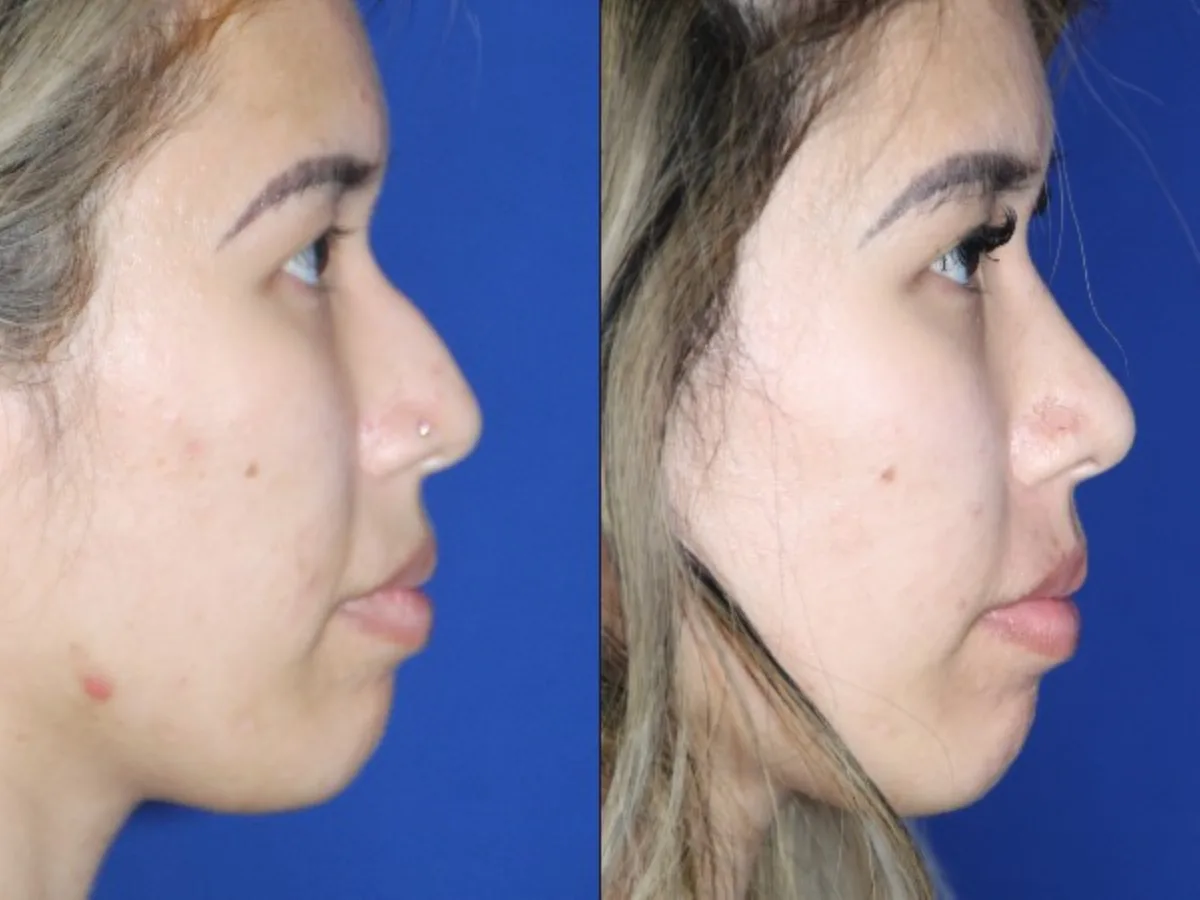
What Happens During Rhinoplasty, Step by Step
A primary rhinoplasty typically takes 1.5 to 2.5 hours; a revision (repeat) rhinoplasty takes longer, because the anatomy is more complex the second time around. There are two recognized approaches:
- Closed approach — all incisions are hidden inside the nostrils. The advantages are no external scar and slightly less immediate tip swelling.
- Open approach — a tiny incision across the columella (the strip of skin between the nostrils) lets the surgeon see the entire framework directly and measure to within half a millimeter. The trade-off is a small, well-hidden incision and a little more early tip swelling.
The open approach offers heightened accuracy, easier and more secure placement of cartilage grafts, and is the preferred option for revision rhinoplasty. Dr. Troell’s track record with that columellar incision is a useful gauge of how well it heals:
“In thirty years, I have only had to do a scar revision to that incision once.” — Dr. Troell
The wall dividing the two sides of the nose — the nasal septum — is often addressed during surgery for two reasons: to straighten it and improve breathing, and to harvest cartilage that is shaped into grafts for the nasal tip. (Cartilage can also be taken from the ear when needed.)
Step 1 — Reshaping the nasal tip
The tip is always addressed first, because it is the most technically demanding part of the nose and the slowest to settle. The technique is chosen to match your specific goal:
| Goal | Technique |
|---|---|
| Narrow a wide or bulbous tip | Cephalic strip — removes a strip of excess cartilage |
| Bring the tip cartilages together | Interdomal suture |
| Refine tip shape | Remove fatty tissue between skin and cartilage |
| Push an under-projected tip forward | Nasal tip cartilage graft |
| Bring an over-projected tip back | Lateral or medial crural overlay |
| Strengthen overall tip support | Columellar strut graft between the nostrils |
Step 2 — Reshaping the bridge
With the tip set, the bridge (dorsum) is reshaped — reducing a hump, narrowing the width, or, in the right patient, raising a low bridge with an implant and cartilage graft. The sequence is deliberate, because the bridge and tip have to read as one continuous, balanced line from the side.
The thread running through both steps is structural support. A nose that looks beautiful but is not adequately supported can droop or shift over time. This is exactly the problem Dr. Troell’s published reconstruction techniques were designed to solve — rebuilding the nasal alar rim and internal valve so the nose stays both open and stable (Otolaryngology–Head and Neck Surgery, 2000; PMID 10652391; and the chapter in Springer’s Advanced Aesthetic Rhinoplasty: Art, Science, and New Clinical Techniques).
What Rhinoplasty Recovery Actually Feels Like
Recovery is the part patients worry about most and are most often pleasantly surprised by. In Dr. Troell’s description of his own patients:
“The advantage of rhinoplasty is that it’s a minimally uncomfortable procedure. One or two days of taking pain medication is all the average patient needs… You usually can breathe through your nose immediately after surgery. Only about five percent of patients have any significant bruising.” — Dr. Troell
Here is the honest, day-by-day version of what to expect:
| What you may experience | What to expect | How long |
|---|---|---|
| Discomfort / pain | Minimal — most patients rate it 1–3 out of 10 | 1–2 days |
| Bruising | Uncommon (~5% significant); more likely if a bony hump was reduced | 1–2 weeks if present |
| Light bleeding / drainage | A little from a nostril is normal | 1–3 days |
| Nasal breathing | You can breathe through the nose right away (slightly stuffy for a couple of days if the septum was harvested) | Improves over 5–7 days |
Your nose is never packed. Even when the septum is straightened, Dr. Troell does not pack the nose — so you can breathe right away. You leave with small adhesive strips and a lightweight aquaplast splint molded over the bridge, which (along with the strips) gently squeezes fluid out from between the skin and cartilage for the cleanest result. The splint and any open-approach sutures come off at 5–7 days; the sutures inside the nose dissolve on their own.
The longer arc matters too. The bridge looks like itself within a few months, but the nasal tip can take one to two years for the last of the swelling to resolve and the final, refined shape to show — which is why an experienced surgeon plans for how the nose will look at two years, not two weeks. A reliable structure is what carries the result through that window.
What Rhinoplasty Is Often Combined With — and Why
Because the nose is judged in the context of the whole face, many patients combine rhinoplasty with a second procedure — one anesthesia, one recovery, and a result that balances more than the nose alone. The most common pairings:
- Septoplasty — straightens the septum to open the airway (and supplies graft cartilage).
- Inferior turbinate reduction — shrinks tissue that swells from allergies to improve airflow. Dr. Troell published one of the early studies on radiofrequency turbinate reduction (Otolaryngology–Head and Neck Surgery, 1998; PMID 9852527).
- Chin implant — one of the most common pairings, because the chin and nose define each other in profile. Balancing a small chin can make a prominent nose look smaller without touching the nose further.
- Eyelid surgery (blepharoplasty), fillers or fat grafting (e.g., under-eye tear troughs), and a peripyriform implant to support the nasal base round out the options.
The whole-face logic is exactly how Dr. Troell frames it: “Consideration of the whole face — we want the end aesthetic result to be harmonious with your face.” If breathing is your main concern, the dedicated guide to functional rhinoplasty covers the airway side in depth.
What Rhinoplasty Results Look Like
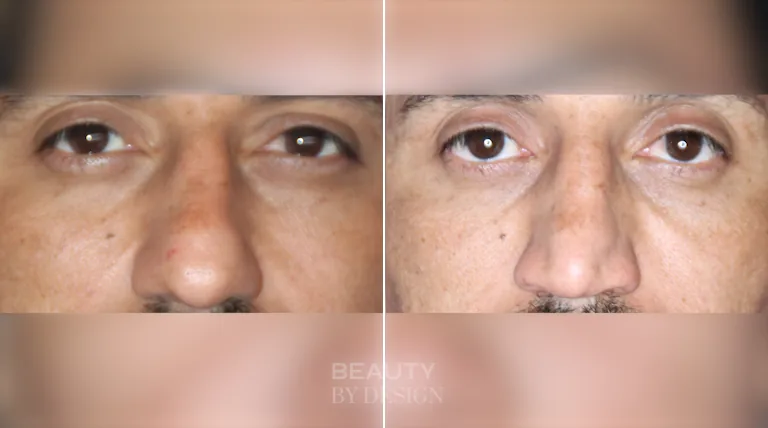
The profile (side) view shows the most dramatic changes a rhinoplasty can make — reducing a high bridge or hump for a smoother line, or raising a flat bridge with an implant and cartilage graft for a more defined one. The front view shows tip refinement and improved symmetry — you can browse more in Dr. Troell's rhinoplasty before-and-after gallery. The two most common goals:
| Goal | How it’s achieved | What it does |
|---|---|---|
| Reduce a high bridge / hump | Rasping or removing bone | A smoother, more refined profile |
| Raise a flat or low bridge | Nasal implant + cartilage graft | A more defined bridge height |
| Refine the nasal tip | Multiple cartilage grafts | A stronger, more feminine or masculine tip |
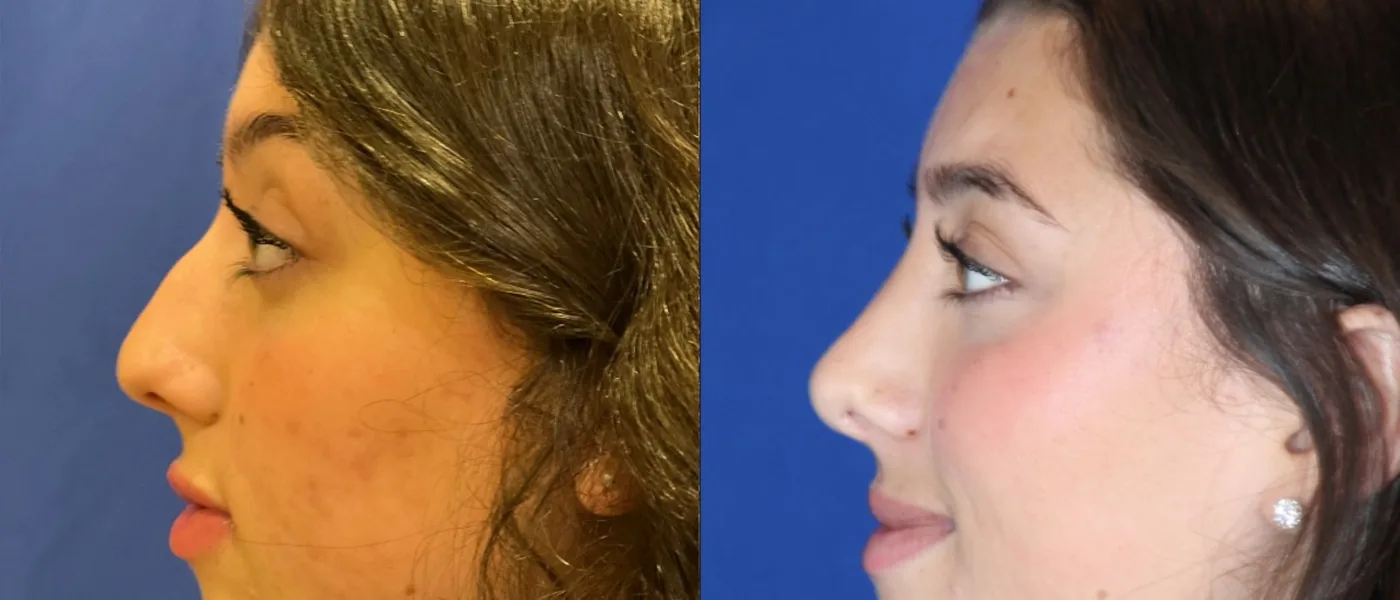
Dr. Troell’s design philosophy. Every rhinoplasty is planned with the entire face in mind — eyes, nose, lips, and chin together. The goal is a result that looks completely natural, never "operated on," and the over-rotated "ski-slope" or pinched tip is deliberately avoided — more on that in rhinoplasty myths, debunked.
What Does Rhinoplasty Cost?
Rhinoplasty is quoted per patient rather than from a flat price list: the fee covers the surgeon’s fee, anesthesia, and the procedure room, and it is set after an in-person consultation, once the surgical plan is known. Revision rhinoplasty costs more than a primary procedure, because it takes longer and is more complex. Troell Cosmetic Surgery is a self-pay specialty practice; financing through CareCredit and Alphaeon is available.
The right number for you depends on your anatomy, whether breathing work or a combined procedure is included, and your surgeon’s experience. For Dr. Troell’s Las Vegas pricing, what the fee includes, and financing options, see the rhinoplasty procedure page.
The Published Work Behind These Techniques
The structural-support principles in this article are not generic — they reflect nasal reconstruction techniques Dr. Troell co-developed and published in the peer-reviewed literature, alongside national procedural data:
- Troell RJ, Powell NB, Riley RW, Li KK. Evaluation of a new procedure for nasal alar rim and valve collapse: nasal alar rim reconstruction. Otolaryngology–Head and Neck Surgery. 2000;122(2):204–211. PMID 10652391.
- Li KK, Powell NB, Riley RW, Troell RJ, Guilleminault C. Radiofrequency volumetric tissue reduction for treatment of turbinate hypertrophy: a pilot study. Otolaryngology–Head and Neck Surgery. 1998;119(6):569–573. PMID 9852527.
- Troell RJ. Nasal Alar Rim Reconstruction for Nasal Rim and Valve Collapse. In: Advanced Aesthetic Rhinoplasty: Art, Science, and New Clinical Techniques. Springer-Verlag, Berlin; 2013.
- American Society of Plastic Surgeons. 2023 Plastic Surgery Statistics Report. ASPS, 2023 (rhinoplasty +6% year over year).
Rhinoplasty Before, During & After: Common Questions
Does rhinoplasty hurt?
Less than most people expect. Dr. Troell describes it as a minimally uncomfortable procedure — the average patient takes pain medication for only one to two days, and most rate their discomfort 1–3 out of 10. The nose is numbed in about 30–45 seconds, and most patients remember little of the procedure itself.
Open vs. closed rhinoplasty — which is better?
Neither is universally "better" — it depends on what your nose needs. The closed approach hides all incisions inside the nostrils with slightly less early tip swelling. The open approach uses a tiny, well-hidden incision across the columella that lets the surgeon see the whole framework and place cartilage grafts with millimeter accuracy; it is the preferred approach for complex cases and revision surgery. In 30 years, Dr. Troell has needed to revise that columellar scar only once.
Why doesn’t the nose get packed?
Nasal packing is what older patients remember as the worst part of nose surgery. Dr. Troell does not pack the nose — even when the septum is straightened — so you can breathe through your nose right after surgery. Instead, light adhesive strips and a molded aquaplast splint gently press fluid out from under the skin for a cleaner result, and they come off at 5–7 days.
Is there a non-surgical (filler) nose job?
Yes — for the right candidate. A small bump on the bridge can sometimes be camouflaged by placing a filler such as Bellafill above and below the bump to create a straighter-looking profile, with no surgery and little downtime. The trade-off is that a "liquid rhinoplasty" only adds volume — it cannot make a nose smaller, narrow a wide tip, or improve breathing — and the result is temporary to long-lasting depending on the product. It suits a select group of patients; surgery remains the option for reducing size or changing structure. Dr. Troell will tell you honestly which one actually fits your goal.
When will I be able to breathe normally?
Usually right away. Because the nose is not packed, most patients breathe through it immediately after surgery. If cartilage was harvested from the septum, you may feel a little stuffy for a couple of days while that settles. Breathing typically improves further as swelling clears over the first 5–7 days — and if a deviated septum or enlarged turbinates were treated, long-term breathing often improves beyond your pre-surgery baseline.
Can rhinoplasty fix my breathing and my appearance at the same time?
Yes — and it is one of the procedure’s biggest advantages. A cosmetic rhinoplasty is frequently combined with septoplasty and turbinate reduction so the same operation refines the nose and opens the airway. Many patients are surprised to learn they can address both at once. The breathing side is covered in depth in the functional rhinoplasty guide.
How long until my nose looks “done”?
You will look presentable once the splint is off at 5–7 days and any bruising fades (only about 5% of patients have significant bruising). The bridge settles into its final look within a few months. The nasal tip is the slowest part — it can take one to two years for the last swelling to resolve and the most refined shape to emerge, which is why surgeons plan for the two-year result.
What’s the difference between primary and revision rhinoplasty?
A primary rhinoplasty is the first operation on a nose; a revision corrects or improves a previous one. Revision is more demanding — scar tissue and altered anatomy make it one of the most difficult procedures in plastic surgery, and it usually takes longer. The open approach and cartilage grafting (from the septum or ear) are especially valuable in revisions for rebuilding structure. The best strategy is a well-supported primary rhinoplasty that does not need a revision rhinoplasty in the first place; nationally, the American Academy of Facial Plastic and Reconstructive Surgery cites a revision rate around 8–10%.
Patient education. This article explains a surgical procedure for a general audience and is not a substitute for an in-person consultation, an individualized risk assessment, or informed consent from a treating surgeon. Rhinoplasty carries real risks, and outcomes vary by patient.
- Last medically reviewed: 2026-06-19 by Robert J. Troell, MD, FACS
- Disclosure: This article describes techniques used by Troell Cosmetic Surgery & Facial Plastic Clinic and references peer-reviewed studies co-authored by Dr. Troell. The practice has a direct interest in patients considering the procedures described. Before/after photographs are of actual patients who have consented to use; individual results vary.

Begin Your Journey with Dr. Troell
Schedule a complimentary consultation with Dr. Troell to discuss your goals, explore your options, and receive an honest, expert assessment. No obligation, no pressure.
Mon–Fri, 8:30 AM – 5:00 PM