

Breast Implant Revision & Exchange in Las Vegas
Correcting, updating, or upgrading a previous augmentation — guided by a published decision algorithm, not guesswork
What is Breast Implant Revision?
Revision (secondary) breast augmentation is any surgery on a breast that has been operated on before — exchanging implants, correcting a complication, or updating a result your body has changed around.
It is genuinely more complex than a first augmentation. Scar tissue, altered anatomy, and stretched soft tissue all raise the stakes, and published data shows secondary surgery carries higher complication and revision rates than primary augmentation. That's exactly why Dr. Troell published a peer-reviewed decision algorithm for primary and secondary breast augmentation in The American Journal of Cosmetic Surgery (2025) — a structured framework for matching each revision problem to the technique with the best evidence behind it. Who evaluates a concern, when a result can fairly be judged, and how a revision is priced are covered in our guide to how revisions actually work.
The most common reasons for revision
- Capsular contracture — the most common implant complication: the scar capsule tightens, making the breast firm, distorted, or painful
- Implant malposition — implants that have shifted, bottomed out, or drifted apart or together
- Rippling — visible or palpable implant edges, especially in thin tissue
- Rupture or deflation — a failed silicone or saline device
- Size or style change — larger, smaller, or a more natural profile than the original choice
- Tissue changes — pregnancy, weight change, and aging altering how the original result sits
The Revision Toolbox
A good revision plan is built from the problem backward. These are the core approaches in Dr. Troell's published algorithm — used alone or in combination:
Implant Exchange
Replacing the device — new size, new profile, or a switch between saline and cohesive silicone gel — delivered with a no-touch funnel technique.
Capsule Correction
Capsulectomy for contracture; capsulorrhaphy — tightening the pocket with sutures or thermal energy — to fix malposition and hold the new implant where it belongs.
Exchange + Lift
Augmentation-mastopexy: exchanging the implant and lifting the breast in one operation — the most demanding combination, where realistic expectations matter most.
SIEF — Exchange with Fat
Simultaneous Implant Exchange with Fat: enriched fat grafted around the new implant to camouflage edges, soften transitions, and add your own tissue coverage.
Convert to Fat Transfer
Removing the implant entirely and restoring volume with natural fat-transfer augmentation — no device to maintain, exchange, or worry about again.
Removal Without Replacement
Sometimes the right revision is none at all — covered on our breast implant removal page.
Why Exchange + Fat Often Beats Exchange Alone
Many revision problems — rippling, visible edges, thin coverage over the implant — aren't really implant problems. They're soft-tissue coverage problems. Swapping the device doesn't fix them; adding your own tissue does.
In SIEF, Dr. Troell exchanges the implant and, in the same operation, grafts centrifugation-purified, stem cell– and PRP-enriched fat over the areas where coverage is thin. The fat softens the transition between implant and chest, camouflages edges, and adds a living layer that ages with you. Fifteen of the 118 patients in his published 15-year fat grafting study chose exactly this combination — and the same enrichment technique drives his standalone fat-transfer augmentation.
His published algorithm also reviews evidence for surgical detail at every step of an exchange: no-touch funnel delivery of the new implant, pocket irrigation protocols, and tranexamic acid to reduce bleeding — the accumulation of small, evidence-backed choices that lowers revision risk the next time around.
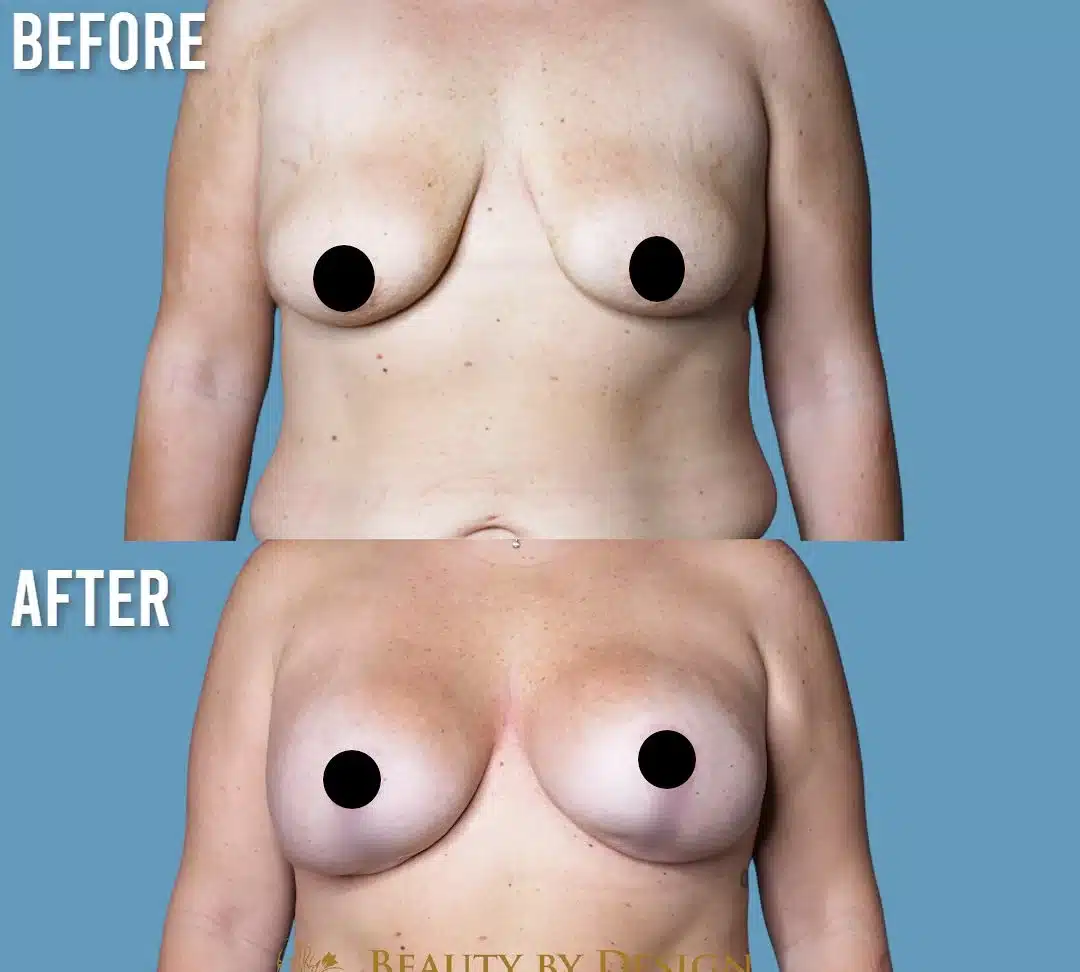
Consented before-and-after cases from his revision practice are collected in the breast revision gallery.
Not Sure Which Revision You Need?
Bring your original operative details if you have them — but don't worry if you don't. The exam and imaging tell most of the story. Free consultations for Las Vegas, Henderson, and Summerlin patients.
Why Choose Dr. Troell for Breast Revision
Revision surgery is where experience shows. A first augmentation is a fresh canvas; a revision is inherited anatomy, inherited scar tissue, and a patient who has already been disappointed once. Dr. Troell’s published algorithm exists precisely because secondary breast surgery deserves structured, evidence-weighed decisions — and honest expectations — rather than a one-size-fits-all redo.
How Much Does Breast Implant Revision Cost in Las Vegas?
Revision pricing varies more than primary augmentation because the operation itself varies more. Your quote is a single, all-inclusive figure given at consultation. The main variables:
- The revision problem — a straightforward size exchange versus contracture correction with capsulectomy
- The new implant — saline versus cohesive silicone gel
- Combined procedures — lift at the same time, or SIEF fat grafting (which adds donor-site liposuction and contouring)
- Anesthesia choice — awake (oral + IV sedation) or general
Troell Cosmetic Surgery is a self-pay specialty surgical practice and does not bill insurance — deliberately. No insurance-imposed restrictions on technique, surgical time, anesthesia choice, or technology. Consultations are free, quotes are transparent, and financing options are available. For national pricing context on implant surgery generally, see our breast implant cost guide.
Recovery Timeline
Immediate Post-Op
Soreness comparable to — often milder than — your original augmentation, managed with a support garment and oral medication.
Early Recovery
Most patients return to desk work within a week for a simple exchange; combined lift or SIEF cases run closer to two.
Settling In
The new implant settles into position as swelling resolves. Exercise restrictions lift progressively.
Final Result
Shape is stable and any grafted fat has established itself — the point where before-and-after comparisons are meaningful.
Request a Consultation
Breast Revision FAQs
Who handles breast implant revision in Las Vegas when the original surgery was done elsewhere?
Revision consultations here are with the operating surgeon: Dr. Troell examines the implant position, capsule, and tissue quality himself and builds the plan on what your chest actually shows — prior operative records help if you can get them, but the exam decides. He is the practice's only surgeon, so the person who plans the revision is the person who performs it and follows it up. A documented revision case is in the revision photo gallery. If your concern is that the two sides no longer match, our guide to when the two breasts no longer match explains when that can fairly be judged.
How do I know if I need a revision or just a removal?
It comes down to what you want your result to be. If you still want volume — just better, softer, or differently sized — revision or SIEF is the conversation. If you're done with implants, removal (with or without fat-transfer restoration) is. The consultation maps both paths honestly so you can choose.
Is revision surgery riskier than my first augmentation?
Published data shows secondary breast surgery carries higher complication and revision rates than primary augmentation — scar tissue and altered anatomy raise the difficulty. That's why technique details and realistic expectations matter more here, and why Dr. Troell published a structured decision algorithm for these cases.
What is capsular contracture and can it come back?
It's the tightening of the natural scar capsule around an implant, making the breast firm or distorted — the most common reason for revision. Treatment usually involves removing the capsule and replacing the implant with evidence-based precautions. Recurrence is possible, which is why prevention details — no-touch delivery, pocket irrigation, meticulous bleeding control — are built into every exchange.
Can I go smaller — or more natural — with my exchange?
Yes. Downsizing, switching implant profile, or converting entirely to fat transfer are all common revision goals. Going smaller sometimes pairs best with a lift or with SIEF fat grafting so the skin envelope matches the new volume.
Do implants have to be replaced every 10 years?
No — that's a myth. Implants aren't lifetime devices, but they don't expire on a schedule either. They're exchanged when there's a reason: a complication, a rupture, or a change in what you want. Routine monitoring is the actual obligation, not routine replacement.
Do you take insurance for revision surgery?
Troell Cosmetic Surgery is a self-pay specialty surgical practice and does not bill insurance. That model is deliberate: no insurance-imposed restrictions on technique, surgical time, anesthesia choice, or technology. Consultations are free, pricing is transparent, and financing options are available.
Explore Related Procedures
Breast Augmentation
The full overview of implant and fat-transfer options
Breast Reduction
Going smaller — reduction mammoplasty for neck, shoulder and back symptoms
Breast Lift
Mastopexy — position without a change in size
Fat Transfer Breast Augmentation
Natural augmentation and restoration with your own enriched fat
Breast Implant Removal
Explant surgery — removal alone, with a lift, or with staged restoration
Tuberous Breast Correction
Constricted or tubular breasts — base, crease, areola and volume planned side by side
Proudly Serving the Las Vegas Valley
Dr. Troell’s practice at 5375 S Fort Apache Rd in Las Vegas sees breast implant revision patients from Spring Valley and Summerlin South, Enterprise, and across the valley to Henderson and North Las Vegas. Las Vegas gets 85 percent of its possible sunshine, about 3,782 hours a year, by NOAA climate normals, so the American Academy of Dermatology’s advice matters here: a broad-spectrum sunscreen of SPF 30 or higher whenever clothing won’t cover a scar.

Ready to Get Your Revision Right?
Whatever went wrong — or simply changed — there's a structured, published way to decide what comes next. Start with an honest conversation.