

Fat Transfer Breast Augmentation in Las Vegas
Natural breast augmentation with your own fat — fifteen years of published clinical results using stem cell– and platelet-enriched fat grafting, without implants
What is Fat Transfer Breast Augmentation?
Fat transfer breast augmentation — often called natural breast augmentation, breast fat grafting, or autologous fat transfer — uses liposuction to remove fat from areas like the abdomen, flanks, or thighs, then purifies and enriches that fat before placing it into the breast.
Because the added volume is your own living tissue, the result tends to look and feel soft and natural rather than like an implant. Dr. Troell published his 15-year clinical experience with this procedure in the Journal of Clinical Medicine (2025), reviewing 118 women treated between 2008 and 2025. That published, refined technique forms the basis of every fat transfer breast augmentation performed at the practice today.
How the procedure works
- Harvest — fat is removed by ultrasound-assisted liposuction from donor areas you choose with Dr. Troell (abdomen, flanks, back, or thighs)
- Purify — the fat is processed by centrifugation and filtration to remove oil, blood, and fluid
- Enrich — your own platelet-rich plasma and adipose-derived stem cells are concentrated back into the graft
- Place — the enriched fat is injected in small amounts, layer by layer, for the best survival
- Contour — the donor areas are sculpted at the same time, so you get slimming and augmentation in one procedure
Considering implants instead — or not sure which is right for you? Our breast augmentation overview compares saline, silicone, and fat-transfer approaches side by side.
Also called natural breast augmentation
Patients arrive at this procedure under several names: natural breast augmentation, breast fat transfer, fat transfer to the breasts, and — in the clinical literature — autologous fat grafting or lipofilling. They all describe the same operation: enhancing the breasts with your own enriched fat instead of an implant. Whichever term you searched for, this page covers how the technique works, who it suits, what results look like, and what it costs in Las Vegas.
Why Fat Processing Determines Your Result
Not all fat grafting is equal. How the fat is handled between harvest and placement largely determines how much of it survives — and Dr. Troell has published head-to-head research on exactly this question.
His comparative study in The American Journal of Cosmetic Surgery tested the two leading fat-processing methods — filtration-washing versus filtration-centrifugation — in patients undergoing breast fat transfer, measuring results by laboratory fat-viability analysis and diagnostic ultrasound. The centrifugation system produced measurably thicker grafted tissue at follow-up: 40% thicker at 10 weeks and 29% thicker at seven months, with fat viability above 90%.
The centrifugation-filtration process removes oil and wetting fluid more completely, compacts the fat, preserves growth factors that washing rinses away, and concentrates the stem cells and progenitor support cells that help the graft establish its own blood supply. It's the same enrichment approach behind Dr. Troell's stem cell–enriched body contouring work.
Who Fat Transfer Breast Augmentation Is For
Dr. Troell's published series included patients across four distinct treatment goals. Your consultation determines which fits your anatomy and goals.
Primary Breast Augmentation
67 of 118 study patients. Natural volume enhancement for patients who want fuller breasts but prefer not to have an implant.
Fat Grafting After Implant Removal
16 of 118 study patients. Restores shape and softness after a patient chooses to have her implants taken out — see our guide to breast implant removal in Las Vegas.
Simultaneous Implant Exchange with Fat (SIEF)
15 of 118 study patients. Fat added at the same time an implant is exchanged, to camouflage edges and add soft-tissue coverage — covered on our breast implant revision & exchange page.
After a Breast Lift or Reduction
16 of 118 study patients. Fine-tunes shape, symmetry, or volume once healing from a mastopexy or reduction mammaplasty is complete.
Why Choose Dr. Troell for Fat Transfer Breast Augmentation
Dr. Troell has performed breast fat grafting for over fifteen years and published his outcomes twice in the peer-reviewed literature — first as a ten-year review, then as the 15-year, 118-patient study this page is built on. Few surgeons offering this procedure anywhere have documented their own results in this much detail.
Results from Dr. Troell's 15-Year Study
118 women, treated between 2008 and 2025, reviewed in the Journal of Clinical Medicine. Here's what the published data showed:
Complications were mostly mild — see the risks section below. No patient in the study developed an oil cyst in the breast. For the full clinical story behind these numbers, read our companion deep-dive: Stem Cell Breast Fat Grafting vs Implants: 15-Year Evidence.
Fat Transfer Breast Augmentation Before & After
Fat transfer results are judged on how natural the outcome looks — the slope of the upper pole, the projection from the side, and skin that moves like it always has. These practice-prepared composites show the same patient from the front and in profile, before and after natural breast augmentation with her own fat.
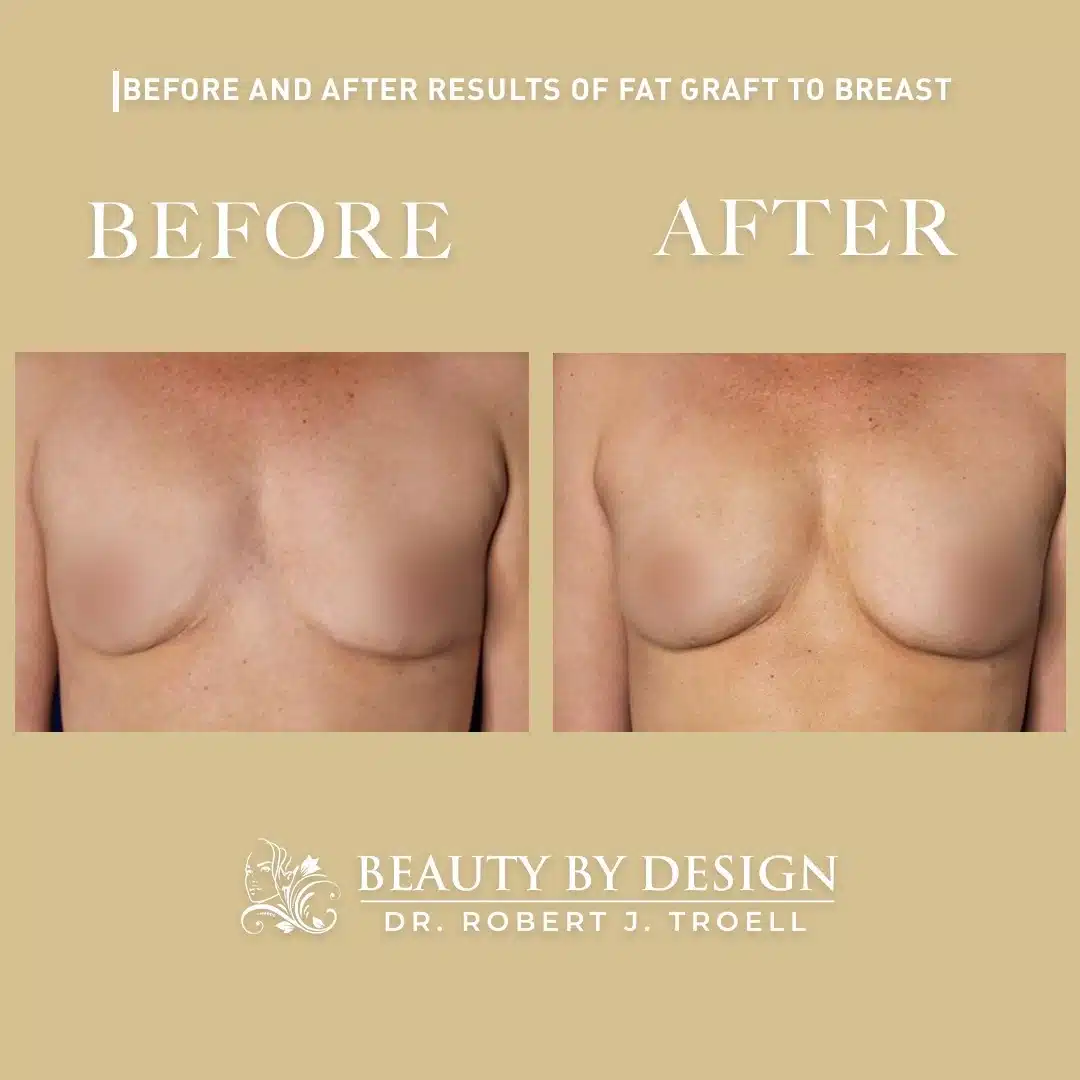
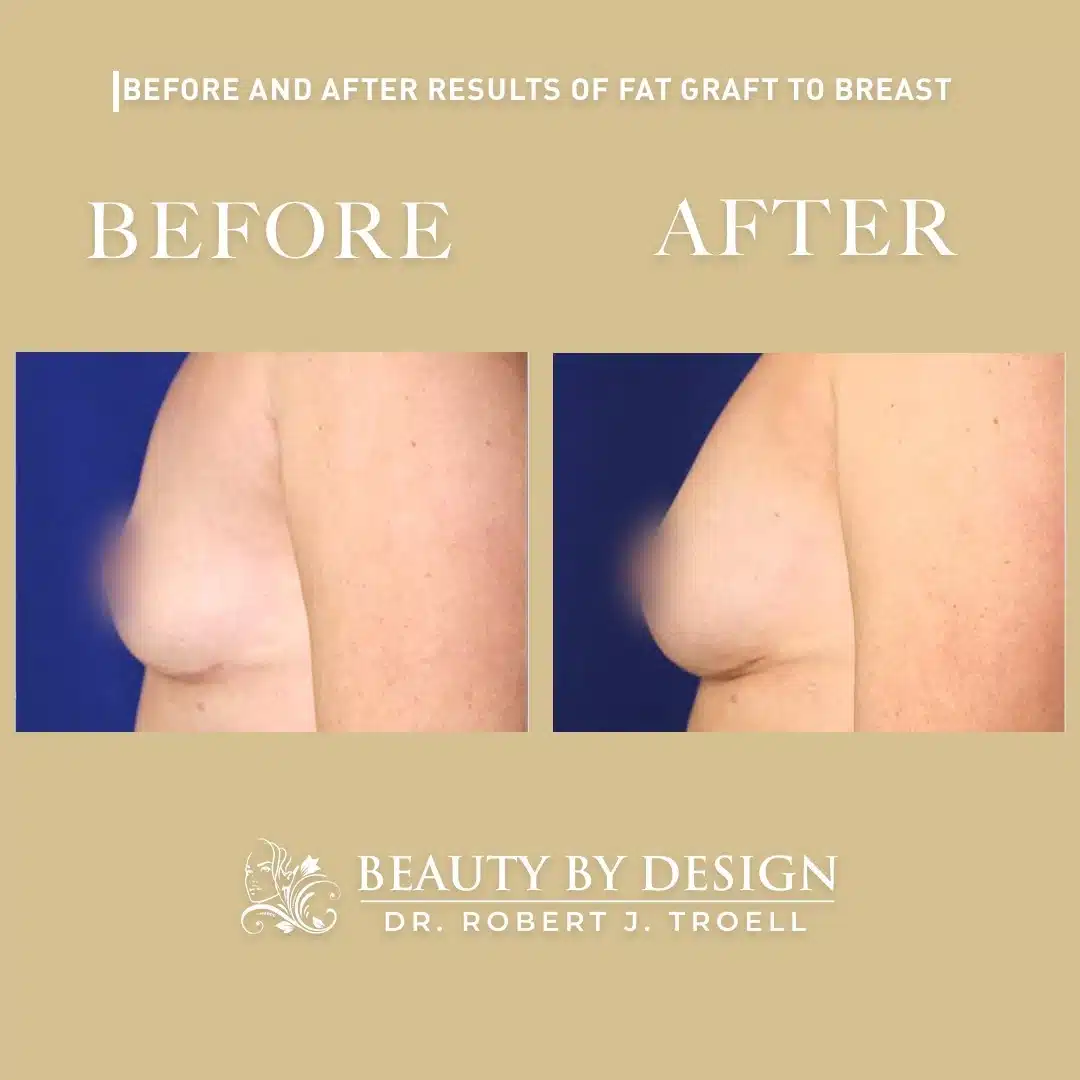
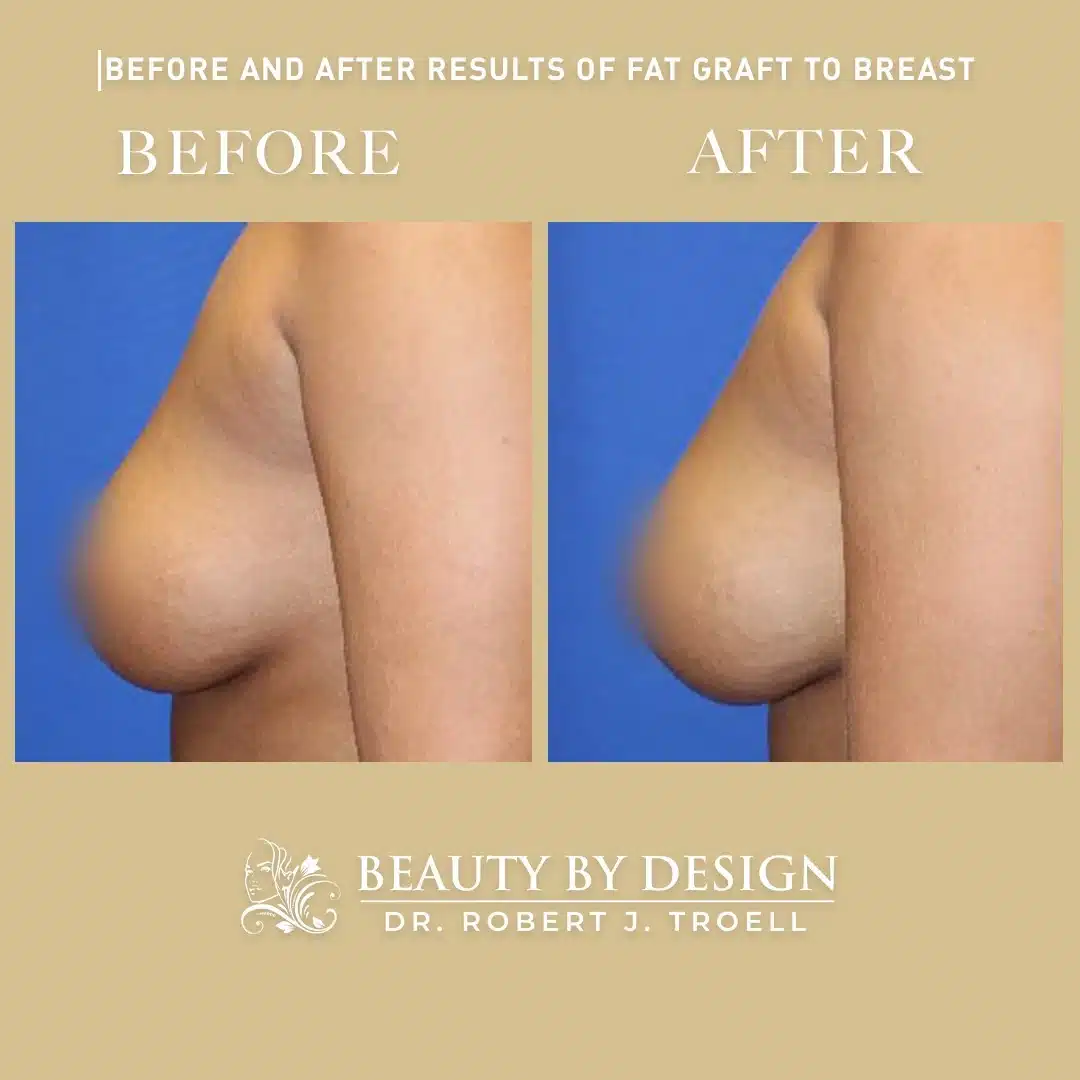
More breast results are in the breast augmentation case gallery. Individual results vary with anatomy, available donor fat, and healing.
What Our Fat Transfer Patients Say
"I have great praise for Dr. Troell, Amy, and all the staff. I interviewed several doctors in the Summerlin area and selected Dr Troell based on his expertise as well as the wonderful service I received from my very first visit. I had a fat transfer breast augmentation and absolutely love the results. I would highly recommend Dr Troell to anyone seeking high quality results with exceptional service."
Fat Transfer Breast Augmentation · Verified Google review · May 2023How Much Does Natural Breast Augmentation Cost in Las Vegas?
Fat transfer breast augmentation is quoted as a single, all-inclusive price at your consultation — there's no insurance middleman, and no surprise line items after the fact.
Because the procedure combines liposuction of your chosen donor areas with the breast fat grafting itself, the price reflects more variables than an implant augmentation. The main factors:
- Donor areas treated — one area (abdomen) versus several (abdomen, flanks, thighs) changes surgical time, and every donor area is fully contoured, not just harvested
- Volume goals — a subtle half-cup enhancement versus maximum-volume grafting
- Anesthesia choice — awake (oral + IV sedation) or general anesthesia
- Staged second session — about 7% of study patients chose one for additional volume; it's priced separately and discussed up front
Troell Cosmetic Surgery is a self-pay specialty surgical practice and does not bill insurance — deliberately. It means no insurance-imposed restrictions on technique, surgical time, anesthesia choice, or technology. Consultations are free, quotes are transparent, and financing options are available. To see how fat transfer pricing compares with implant augmentation nationally, our breast implant cost guide covers both.
As a planning range, most fat transfer breast augmentation patients in Las Vegas invest between $7,000 and $12,000 all-in — the same range our national cost guide reports — with the exact quote set by the donor areas, volume goals, and anesthesia choice above. It also helps to weigh how long the result lasts: implants are not considered lifetime devices, while grafted fat that establishes its blood supply over the first months is your own living tissue. Dr. Troell's published 15-year follow-up tracked results over that horizon — with no device to maintain or exchange.
Am I a Candidate for Fat Transfer Breast Augmentation?
The best candidates have enough donor fat to harvest, healthy breast and body tissue, and realistic goals — typically an increase of about half to one cup size per session. Dr. Troell reviews your health history carefully, since several medical factors can lower how well transferred fat survives.
- Enough donor fat available in the abdomen, flanks, back, or thighs
- Desire for a natural, moderate increase in breast volume or shape
- At a stable, healthy weight
- Non-smoker, or willing to stop smoking or vaping before and after surgery
- No uncontrolled diabetes, active autoimmune disease, or prior breast radiation
- Comfortable with the possibility of a second, staged session for additional volume
Good to Know: Second Sessions Are Common
In the published study, about 7% of patients chose a second, staged fat grafting session to add more volume. That's a normal, expected path to your desired size with fat transfer — and Dr. Troell discusses the possibility with you before your first procedure, not after.
What Fat Transfer Breast Augmentation Can Achieve
Uses your own tissue, so breasts tend to look and feel soft and natural — no one can feel an implant edge, because there isn't one.
Slims the donor area with liposuction while adding volume to the breast — two results from one procedure.
Avoids implant-specific concerns like capsular contracture, rupture, and future implant-exchange surgery.
The published study showed only 7.6% of patients needed any revision procedure.
From Dr. Troell's Peer-Reviewed Publications
This page is based on Dr. Troell's own published clinical research — not borrowed statistics.
The 15-year review found high patient satisfaction and low complication rates using centrifugation-filtration fat processing combined with platelet-rich plasma and adipose-derived stem cell enrichment, across primary augmentation, post-explant restoration, implant exchange, and post-lift refinement.
The study also confirmed, citing prior blinded radiologist research, that fat grafting to the breast does not interfere with a radiologist's ability to read a mammogram for cancer surveillance.
- Troell RJ. Breast Augmentation in Body Contouring Using Autologous Stem Cell-Enriched Fat Grafting: Fifteen-Year Clinical Experience. J Clin Med. 2025;14:5607. doi:10.3390/jcm14165607 (open access)
- Troell RJ. Breast Fat Grafting: Comparing Filtration-Centrifugation to Filtration-Washing Fat Processing. Am J Cosmet Surg. 2024;41(2):100–112. doi:10.1177/07488068221108547
- Troell RJ. Aesthetic Primary and Secondary Breast Augmentation: Proposed Algorithm for Optimal Cosmetic Outcomes While Minimizing Complications. Am J Cosmet Surg. 2025. doi:10.1177/07488068251314535
Recovery Timeline
Immediate Post-Op
Mild to moderate soreness at the donor and breast sites. A supportive bra is worn continuously. Light walking is encouraged to support circulation.
Early Recovery
Swelling and bruising gradually improve. Most patients return to desk work within one to two weeks. Donor sites may feel firm as healing continues.
Gradual Return
Most daily activities resume. Continued massage and compression at donor sites, as directed, help smooth the healing process.
Volume Stabilizes
Initial swelling resolves and the breast settles into its long-term shape. The published study found volume stable by three months, absent weight change.
Final Results
Surviving fat cells are considered a permanent result. Long-term follow-up showed 75–85% of the transferred volume persisting.
Risks and Potential Complications
In the published 15-year study, the overall complication rate was 11.9%, and no patient developed a breast oil cyst. Complications that occurred were generally mild and treatable.
Reported in the published study (n=118)
- Seroma at the donor (liposuction) site — 7.6%
- Palpable firm areas in the breast — 3.4%, resolved with injection treatment
- Suspected soft-tissue infection — 0.8%, resolved with antibiotics
- Temporary nipple vascular change after a combined lift — 0.8%
General considerations
- Swelling, bruising, or temporary numbness at donor and treated sites
- Some degree of fat reabsorption is expected and normal
- Possible need for a second, staged session for additional volume
- Standard surgical risks, including reaction to anesthesia or bleeding
This information reflects outcomes reported in a specific published clinical study and is provided for general education. It is not a guarantee of results. Individual outcomes vary based on anatomy, health history, and adherence to pre- and post-operative instructions.
Request a Consultation
Fat Transfer Breast Augmentation FAQs
Who in Las Vegas does breast augmentation with your own fat instead of implants?
Troell Cosmetic Surgery offers fat-transfer (natural) breast augmentation in Las Vegas, and Dr. Troell has published a 15-year comparative review of fat transfer versus implants — the long-run trade-offs on this page come from that experience, not marketing copy. The exam determines whether your fat supply and breast envelope make you a candidate; real patient results are in the augmentation photo gallery.
How much bigger will my breasts get?
Fat transfer typically adds about half to one cup size per session. Patients wanting a larger increase may choose a second, staged session — about 7% of patients in Dr. Troell's published study did this.
How much of the transferred fat actually survives?
In the published 15-year study, roughly 75–85% of the enriched, purified fat volume persisted long-term, confirmed by diagnostic ultrasound measurement.
Will fat grafting affect my mammograms?
Research cited in the study found that fat grafting to the breast does not meaningfully interfere with a radiologist's ability to read a mammogram for cancer surveillance. Always tell your radiologist about any prior fat grafting.
Is fat transfer breast augmentation safe?
When performed by an experienced, board-certified surgeon using purified, enriched fat and careful injection technique, complication rates are low. The published study reported an 11.9% overall complication rate, with no cases of breast oil cysts.
How is the fat prepared before it's placed in the breast?
Harvested fat is spun in a centrifuge and filtered to remove oil, blood, and fluid, then enriched with the patient's own platelet-rich plasma and stem cells before being injected in small amounts within one to two hours of harvesting.
Can this be combined with a breast lift or implant removal?
Yes. The published study included patients who combined fat grafting with implant removal, implant exchange, and breast lift or reduction procedures, in addition to those having primary augmentation.
Do you take insurance for natural breast augmentation?
Troell Cosmetic Surgery is a self-pay specialty surgical practice and does not bill insurance. That model is deliberate: no insurance-imposed restrictions on technique, surgical time, anesthesia choice, or technology. Consultations are free, pricing is transparent, and financing options are available.
Explore Related Procedures
Breast Augmentation with Implants
Saline and silicone options compared — and how they differ from fat transfer
Breast Reduction
Going smaller — reduction mammoplasty for neck, shoulder and back symptoms
Breast Lift
Mastopexy — position without a change in size
Breast Implant Removal
Explant surgery, with or without fat-transfer restoration afterward
Breast Implant Revision & Exchange
Correcting or updating a previous augmentation — including SIEF
Liposuction
The same donor-area contouring, as a standalone body procedure
MTF Breast Augmentation
Fat transfer and implants for transfeminine patients
Tuberous Breast Correction
Constricted or tubular breasts — base, crease, areola and volume planned side by side
Proudly Serving the Las Vegas Valley
Dr. Troell’s practice at 5375 S Fort Apache Rd in Las Vegas sees fat transfer breast augmentation patients from Spring Valley and Summerlin South, Enterprise, and across the valley to Henderson and North Las Vegas. Las Vegas gets 85 percent of its possible sunshine, about 3,782 hours a year, by NOAA climate normals, so the American Academy of Dermatology’s advice matters here: a broad-spectrum sunscreen of SPF 30 or higher whenever clothing won’t cover a scar.

Ready to Discuss Natural Breast Augmentation?
A consultation with Dr. Troell is the first step — an honest conversation about your goals, your anatomy, and whether fat transfer is the right approach for you.