
Cheek Implants in Las Vegas
Malar and submalar implants — permanent cheekbone projection or permanent fill for the hollow beneath it, chosen from which part of the cheek is actually short
What Are Cheek Implants?
Cheek implants are solid, biocompatible forms placed on the cheekbone itself, under the soft tissue, to add projection or fullness that does not fade. Also called malar implants, cheekbone implants or cheek augmentation, they sit against bone rather than in the fat layer — which is why the result is structural and why it is judged on a profile view as much as a front one.
They answer a different question from a filler or a fat transfer. Injectables add volume to soft tissue and are re-treated on a schedule; an implant changes the underlying shape once. Our guide to cheek fillers covers the injectable route in full, and the long-form comparison of midface volume options over time sets fat grafting beside implants with the trade-offs named.
The decision this page exists to explain is the one that comes before any of that: which part of the cheek is short. It is not one procedure with one implant.
Malar, Submalar, or Both
Three different complaints, three different implants, and the examination decides which. Choosing the wrong one is how a cheek implant ends up looking like a cheek implant.
Malar — The Cheekbone
For a cheekbone that is flat or low to begin with. The implant sits over the body of the zygoma and adds width and projection at the highest point of the cheek. This is the lifelong-trait version of the complaint, and it is usually what “I want cheekbones” means.
Submalar — The Hollow Below
For the gaunt, shadowed area under the cheekbone, where soft tissue has thinned with age, weight loss or low body fat. The bone may be fine; the padding over it is not. Adding malar projection here makes the hollow read deeper, not better.
Combined
A combined or “shell” shape covers both zones where the cheekbone is modest and the area beneath it has emptied — common in faces that have lost weight rapidly.
One Side or Two
Cheeks are rarely identical. Sizing is decided side by side, and the two implants are frequently not the same size. A plan that quotes one size for both has not examined the asymmetry.
Stock or Custom
Most cheeks are served by a stock implant shaped and trimmed during surgery. Where the bone deficit is unusual, a patient-specific design made from a CT scan is possible — see custom facial implants.
Where It Goes In
Cheek implants are usually placed through an incision inside the mouth, above the gumline, which leaves no visible scar; a lower-eyelid approach is used where that suits the anatomy or a combined eyelid procedure is planned.
When an Implant Is the Answer and When Fat Is
Both are permanent options and Dr. Troell performs both, so the honest answer is that they solve different shortages.
An implant is the better fit when the shortage is skeletal. If the cheekbone itself is flat or low, no amount of grafted fat creates an edge that the bone does not have — fat sits on the contour it is given. An implant changes that contour, projects on a profile view, and does not depend on how much of it survives.
Fat is the better fit when the shortage is soft tissue and diffuse. Hollowing that spreads across the mid-cheek, the temple and the tear trough at once is a volume problem, not an edge problem, and grafted fat blends across all of it in one sitting. It also needs a donor site and a tolerance for the portion that does not take. Neither is the answer if the cheek has descended rather than emptied, and neither is right if it is genuinely full — that is buccal fat removal, the opposite operation.
In practice the two are often combined, and Dr. Troell has published on exactly that combination: his 2026 paper in The American Journal of Cosmetic Surgery describes permanent composite midface volume replacement using Artefill, Silastic implants and stem cell-enriched fat grafting together.[1] Which combination your face calls for is set at the examination. If you want the long version of the comparison, with how each option behaves over the years, it is in our guide to midface volume augmentation.
The Nerve Under the Cheek, and the Published Safe Zone
The commonest complication of facial implant surgery is not infection or the implant moving. It is nerve injury. In a 2025 systematic review of 117 studies and 4,273 patients, nerve injury accounted for 2.1 percent — ahead of hematoma at 1.4 percent, infection at 1.0 percent, implant displacement at 0.59 percent and bone resorption at 0.68 percent.[2]
The nerve in question is the infraorbital nerve, which supplies sensation to the mid-cheek, the side of the nose, the upper lip and the lower eyelid. It leaves the skull through a small opening below the eye socket — directly above where a cheek implant is placed. Injure it and the result is numbness in exactly the region the operation was meant to improve.
It has a mapped location. Measuring 44 adult hemifaces on CT, a 2013 study in Aesthetic Surgery Journal found the infraorbital foramen sits on average 8.61 mm below the infraorbital rim in men and 8.25 mm in women, most often in line with the second premolar, and defined a safe zone of dissection beneath it.[3] That is the anatomy a cheek implant is placed around, and knowing where the opening sits is the difference between a technical step and a risk.
It is also why the pre-operative examination looks at the lower eyelid and the bone beneath it, not only at the cheekbone. Dr. Troell has published separately on implants engineered for the bone immediately below the eye — see infraorbital rim implants — which is the neighbouring problem to this one.
What the Published Record Reports
Two things about those numbers deserve saying plainly. The systematic review is 56 percent reconstruction and 33 percent aesthetics — it pools implants placed after trauma and cancer with implants placed for appearance, so it is not a cosmetic-only figure. And the submalar series is one surgeon’s consecutive patients over 26 years, 48 of them: its complications were 2.1 percent transient infraorbital numbness, 1.1 percent prolonged swelling and 1.1 percent capsular contraction needing a minor adjustment, with no infection, migration, extrusion or facial-nerve injury reported.[4] A small series from one practice is encouraging, not conclusive.
On materials, the review found patient-specific implants showed promise in reducing complications and that polyethylene implants had the highest rate of complication-free recovery — but its own conclusion is that performance varies and that standardised reporting is still needed before any material is called the winner. No practice should tell you one material is simply best; what it can tell you is which one it is proposing for your anatomy, and why.
Cheek Implant Results from This Practice
Eight of Dr. Troell’s own cheek, malar and submalar implant patients are published with consent in the malar implant gallery, including two whose implants were placed at the same time as a facelift and one combined with upper eyelid surgery. Each case names what was done rather than only showing the pair of photographs.
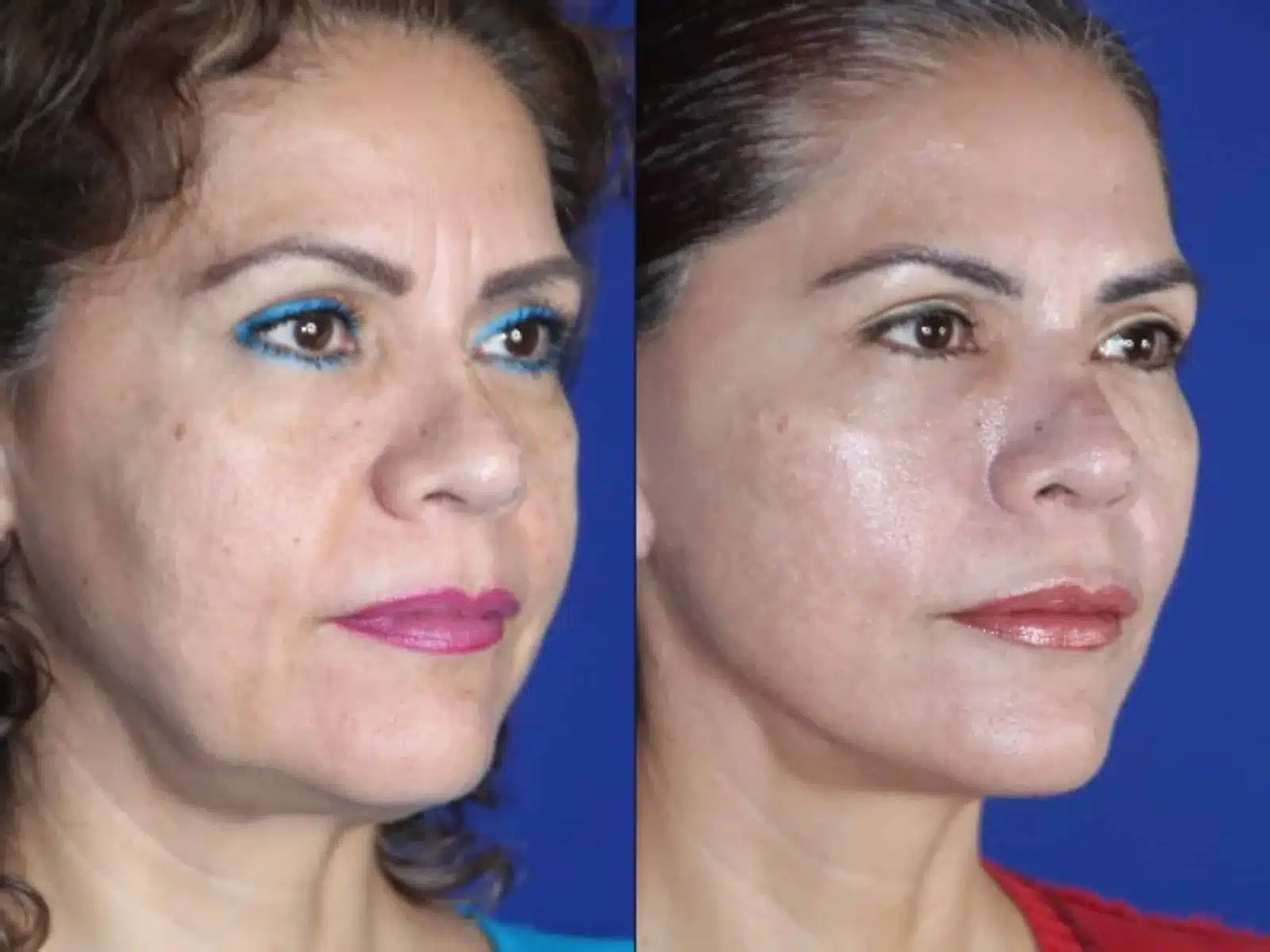
Look at them on the profile view as well as the front. A cheek implant is a projection change, and the front view is the one that hides it. The three-quarter view below is Patient 1 from that gallery, a submalar implant placed beneath the cheekbones during a facelift and neck lift, where the restored volume under the malar region reads at the angle a front view flattens.
Why Choose Dr. Troell for Cheek Implants
Permanent midface volume is something Dr. Troell has published on rather than only performed: his 2026 paper in The American Journal of Cosmetic Surgery, Permanent Composite Midface Volume Replacement: Artefill, Silastic Implants, and Stem Cell Enriched Fat Grafting, sets out how the permanent options are combined in the midface.[1] He trained in otolaryngology — head and neck surgery before facial plastic surgery, which is the route through the facial skeleton and its nerves.
Dr. Robert J. Troell, MD, FACS is a Diplomate of the American Board of Facial Plastic and Reconstructive Surgery (ABFPRS), a Diplomate of the American Board of Cosmetic Surgery (ABCS), and a Diplomate of the American Board of Otolaryngology – Head and Neck Surgery, with over 30 years in practice and training at the University of South Florida and Stanford University, where he later served as a Clinical Professor. He has held an active Nevada medical license since 2001 and has practiced in Las Vegas for more than 20 years. You can review his published work and credentials and decide for yourself.
Consultations are with Dr. Troell himself — he is the only surgeon at the practice, and the person who examines you is the person who operates. Consultation, surgery, and every follow-up visit happen at the same office, 5375 S Fort Apache Rd in Las Vegas, which serves patients from Spring Valley and Summerlin South, Enterprise, and across the valley to Henderson and North Las Vegas.
How Much Do Cheek Implants Cost in Las Vegas?
Cheek implants are quoted at consultation for the operation your examination calls for. There is no single number, because the operation is not a single operation.
What moves the figure:
- Malar, submalar or combined — and whether the two sides need different sizes.
- Stock or patient-specific. A custom implant designed from a CT scan carries its own fabrication cost that a shaped stock implant does not.
- Whether anything is combined with it. Cheek implants are frequently placed alongside a facelift, eyelid surgery or fat grafting, which changes theatre time rather than adding two separate prices.
- Which anesthesia pathway the procedure uses, and the facility time that goes with it.
Troell Cosmetic Surgery is a cash-pay practice: you are quoted for the operation, and the quote is what it costs. Financing options are available. If you are weighing the cost of an implant against years of repeated injectable treatment, the arithmetic is set out honestly in our guide to midface volume options.
Cheek Implant Recovery Timeline
Swelling in the midface is generous and slow, and an intraoral incision means eating differently for a while. Your own instructions are written for your own operation.
Peak Swelling
Swelling and bruising peak in the first days. A soft or liquid diet and mouth rinses are used where the incision is intraoral; sleeping with the head elevated helps.
Back in Public
Most patients return to sedentary work within one to two weeks. Cheeks still look fuller than the final result, and smiling can feel tight while the tissue is swollen.
Building Back Up
Strenuous exercise and anything that could strike the face wait on instruction. Numbness or altered sensation over the cheek and upper lip is common early and usually settles.
Settled Contour
The last of the midface swelling resolves over months, and the contour you judge is the one at three to six months — not the one in the mirror at three weeks.
Healing a face in Las Vegas also means healing in a great deal of sun: the city gets 85 percent of its possible sunshine, about 3,782 hours a year, by long-term NOAA climate normals.[5] Where the implant went in through the mouth there is no external scar to protect — but where a lower-eyelid incision was used, the American Academy of Dermatology advises a broad-spectrum sunscreen of SPF 30 or higher whenever clothing won’t cover a scar,[6] and on an eyelid nothing does.
$1,000 Off Facial Implants
For a limited time, save $1,000 on facial implants placed by Dr. Troell — cheek implants included. Schedule your complimentary consultation to learn more and secure your special pricing.
Request a Consultation
Cheek Implant FAQs
What is the difference between malar and submalar cheek implants?
A malar implant sits over the cheekbone itself and adds projection and width at the highest point of the cheek — the answer when the bone is flat or low. A submalar implant fills the hollow beneath the cheekbone, where soft tissue has thinned with age, weight loss or low body fat. They treat opposite complaints, and putting a malar implant on a submalar problem makes the hollow read deeper. A combined shape covers both zones.
Will I have a visible scar from cheek implants?
Usually no. Cheek implants are most often placed through an incision inside the mouth, above the gumline, which leaves nothing visible on the face. A lower-eyelid approach is used where the anatomy suits it or where eyelid surgery is being done at the same time; that incision sits in the lash line or behind the eyelid. Which route your operation uses is part of the plan you are given before you agree to it.
Are cheek implants permanent, and can they be removed?
They are permanent in the sense that they do not dissolve or need topping up, unlike a filler. They are also not irreversible: an implant can be removed or exchanged in a further operation, through the same incision. In a 2025 systematic review of 117 studies, implant displacement was reported in 0.59 percent of cases and bone resorption in 0.68 percent.[2]
Cheek implants or fat transfer — which should I have?
It depends on whether the shortage is bone or soft tissue. If the cheekbone itself is flat, fat will sit on the contour it is given rather than create an edge, and an implant is the better fit. If hollowing is diffuse across the mid-cheek, temple and under-eye at once, grafted fat blends across all of it. The two are often combined; Dr. Troell has published on combining permanent midface options in The American Journal of Cosmetic Surgery.[1] The long comparison is in our midface volume guide.
Will my face go numb after cheek implants?
Altered sensation over the cheek and upper lip is common in the early weeks and usually settles. Lasting numbness is the complication to ask about: nerve injury was the most frequent problem in a review of 117 studies and 4,273 patients, at 2.1 percent.[2] The nerve involved leaves the skull just below the eye socket — on average 8.61 mm below the infraorbital rim in men and 8.25 mm in women — and a published safe zone of dissection beneath it has been mapped on CT.[3]
Do I need a custom cheek implant, or is a stock one enough?
Most cheeks are well served by a stock implant shaped and trimmed during surgery to the bone in front of the surgeon. A patient-specific implant designed from your own CT scan is worth considering where the bone deficit is unusual or asymmetric; the 2025 review found patient-specific designs showed promise in reducing complications, while stopping short of calling any material or approach the winner.[2] See custom facial implants for how a patient-specific design is made.
Where would my cheek implant surgery actually happen, and who is watching me while I’m sedated?
Worth asking before you pay a deposit anywhere, because “in-office surgery” can mean very different things. At Troell Cosmetic Surgery there are two pathways and you are told which one your procedure uses: procedures under general anesthesia are performed at an AAAASF-accredited surgical facility, and awake procedures are performed in the office under local anesthesia with IV sedation, continuously monitored throughout, with same-day discharge. Dr. Troell is ACLS-certified, is a Diplomate of the American Board of Sleep Medicine, and holds hospital privileges at Summerlin Hospital Medical Center should a complication ever need hospital care. For context on what you are being monitored against, infection was reported in 1.0 percent of cases across 117 published studies of facial implants.[2] What you should leave a consultation knowing is which pathway your procedure uses, where that building is, and who is in the room.
How long is recovery from cheek implants?
Most patients are back to sedentary work within one to two weeks, with a soft diet early if the incision is intraoral. Strenuous exercise and contact activity wait on instruction. Midface swelling is slow: the contour worth judging is the one at three to six months, not at three weeks.
Can cheek implants be done at the same time as a facelift or eyelid surgery?
Frequently, and there is published support for the combination: a series of 48 patients who had submalar implants placed with a facelift by one surgeon reported 95.7 percent satisfaction, with 2.1 percent transient infraorbital numbness and no infection, migration or extrusion.[4] Two of the practice’s own gallery cases were implants placed with a facelift and one with upper eyelid surgery. Whether combining is right for you is decided at the examination.
How much do cheek implants cost in Las Vegas?
They are quoted at consultation for the operation your examination calls for. Malar, submalar or combined; stock or patient-specific; one side or two at different sizes; whether anything is combined with it; and the anesthesia and facility time that follows all move the figure. This is a cash-pay practice and financing options are available.
Explore Related Procedures
Facial Implants
The full overview — cheek, chin, jawline and temple implants
Chin Augmentation
Projection for a weak or recessed chin, planned on the profile
Facial Fat Grafting
Your own fat for diffuse facial volume loss, alone or with an implant
Malar Implant Gallery
Eight consented cheek, malar and submalar implant patients
Midface Volume Options
Fat, filler and implants compared over the long term
Facelift
When the tissue has descended as well as emptied
Proudly Serving the Las Vegas Valley
Research Cited on This Page
- Troell RJ. Permanent Composite Midface Volume Replacement: Artefill, Silastic Implants, and Stem Cell Enriched Fat Grafting. The American Journal of Cosmetic Surgery 2026. doi:10.1177/07488068261440417
- Kauke-Navarro M, Knoedler L, Baecher H, et al. A systematic review of implant materials for facial reconstructive and aesthetic surgery. Frontiers in Surgery 2025;12:1548597. doi:10.3389/fsurg.2025.1548597. PMID 40225117 (117 studies, 4,273 patients, mean follow-up 34 months; 56% reconstruction / 33% aesthetics / 10% both; overall complication rate 4.4%; nerve injury 2.1%, hematoma 1.4%, infection 1.0%, bone resorption 0.68%, implant displacement 0.59%; orbital, chin and malar the most-studied regions)
- Raschke R, Hazani R, Yaremchuk MJ. Identifying a safe zone for midface augmentation using anatomic landmarks for the infraorbital foramen. Aesthetic Surgery Journal 2013;33(1):13–18. doi:10.1177/1090820X12468752. PMID 23220876 (44 adult hemifaces on CT; infraorbital foramen on average 8.61 mm below the infraorbital rim in men and 8.25 mm in women, most often in line with the second premolar)
- Delaney S, Kridel RWH. Enhancing Facelift With Simultaneous Submalar Implant Augmentation. Aesthetic Surgery Journal 2019;39(4):351–362. doi:10.1093/asj/sjy135. PMID 29846508 (48 consecutive patients, single surgeon, 1991–2017; 95.7% satisfaction; 2.1% transient infraorbital hypoesthesia, 1.1% prolonged swelling, 1.1% capsular contraction; no infection, implant migration, extrusion or facial nerve injury)
- Current Results — Las Vegas weather averages, from NOAA NCEI long-term climate normals (85% of possible sunshine; about 3,782 hours of sunshine a year; 210 mainly clear days)
- American Academy of Dermatology — Scars: Diagnosis and Treatment (“always wearing sunscreen when clothing won’t cover your scar”; a broad-spectrum sunscreen with SPF 30 or higher)
Sources checked September 28, 2026. The published literature describes how the field augments the cheek and what it reports going wrong; your own plan is set at an examination of your own face. Individual results vary.

Find Out Which Part of Your Cheek Is Short
Malar, submalar or neither — an examination of the bone and the soft tissue over it, and a plan that says which, what size, and on which side.