

Infraorbital Rim Implants: Custom Under-Eye & Midface Restoration | Dr. Troell
Published August 20, 2026 · By Dr. Robert J. Troell, Board-Certified Facial Plastic Surgeon
Dr. Robert J. Troell, MD, FACS

When the Hollow Under Your Eyes Is Actually in the Bone
The short answer: custom infraorbital rim implants are patient-specific silicone (Silastic) implants, designed from your own 3D CT scan, that rebuild the bony rim beneath the eye where aging has literally receded the skeleton — the structural cause of under-eye hollowing that fillers and fat can soften but never truly correct. In Dr. Robert Troell’s published 250-patient series on permanent midface volume replacement, the tear trough was the single most common treatment site, with 95.6% overall patient satisfaction across the options studied.
If you have tried under-eye filler and watched the shadow return — or been told you are “not a filler candidate” at all — the missing piece of the explanation is usually bone. This guide covers how the under-eye skeleton changes with age, why standard tear trough implants don’t fit every face, and how custom infraorbital rim and zygomatico-orbital implants are designed, built, and placed. It is the surgical companion to our guide on tear trough fat grafting, which covers the soft-tissue side of the same problem.
Why Under-Eye Hollows Deepen With Age
The hollow, shadowed look under the eyes — the tear trough — develops from two changes working together beneath the skin.
The soft tissue thins
Fat and collagen in the lower-lid and midface gradually thin and drift downward, leaving less cushioning between the skin and the bone below. This is the layer most treatments target — and the layer fillers and fat grafting replace.
The bone itself recedes
The often-overlooked second change is skeletal. The orbital rim — the bony ring that frames the eye socket — slowly resorbs with age, particularly along its lower and outer edges, and the maxilla (the bone of the upper jaw and midface) loses volume with it. Peer-reviewed skeletal research has documented these changes directly: the bony frame that once held the skin and fat forward literally shrinks back, deepening the hollow and casting new shadows across the under-eye and midface. Neighboring zones lose volume too — the cheekbone (malar) prominence, the zygomatic arch, and even the temple region, which we cover separately in our guide to temple hollowing.
One anatomical detail matters enormously for implant design: the cheekbone and zygomatic arch curve outward (a convexity), while the front face of the maxilla just below the lower eyelid curves inward (a concavity). An implant that restores this area well has to follow both curves precisely — which is exactly why off-the-shelf shapes struggle here, and why this became a custom-design problem.
Because aging involves both layers, treatments that address only one often fall short of a natural, lasting result. That is the honest reason some patients see limited improvement from filler alone.
What Are the Options for Treating Tear Trough Hollows?
The most common treatment offered today is a temporary hyaluronic acid (HA) filler such as Juvéderm or Restylane — not because it is the definitive fix, but because it is widely available and needs no surgery. Fillers add soft-tissue volume for a limited time; they cannot rebuild a receded bony rim or lift the structures the bone once supported.
Patient-specific implant design sits at the opposite end of the spectrum: it is a niche surgical skill, and relatively few practices offer it — most aesthetic injectors and even many surgeons are simply never trained in designing and placing individualized implants. Long-term midface volume replacement generally falls into these categories, all covered in Dr. Troell’s published 250-patient review:
- Facial implants — standard or custom Silastic implants placed surgically on the bone for structural support;
- Fat grafting — your own purified fat restoring soft-tissue volume, with nanofat (stem cells, stromal vascular fraction and growth factors) for skin quality;
- Permanent dermal filler (Bellafill) — PMMA microspheres in a collagen gel that stimulate your own collagen production.
These are not rivals so much as tools for different layers — bone, soft tissue, and skin — and they are often combined. For a side-by-side comparison of the long-term options, see our midface volume guide. This article focuses on the implant lane — and specifically on when a custom implant earns its place.
The Standard Tear Trough and Midface Implants
Several pre-shaped (“standard”) Silastic midface implants exist, and in the right anatomy they work well:
- Malar implants — placed over the cheekbone itself to restore or enhance projection;
- Submalar implants — placed just below the cheekbone, filling the hollow that develops with age or weight loss;
- Tear trough implants — placed beneath the lower eyelid to soften the hollow, shadowed look that reads as tired;
- Combined malar–submalar implants — broader coverage for patients who need volume restored across the whole midface.
The honest limitation: a standard shape is designed for an average skeleton, and bone loss is not average. Standard midface implants frequently need additional adjacent volume — filler or fat — to reach a fully balanced result, because the implant covers only part of the deficient surface. You can see consented examples of midface implant results in our malar implant gallery.
Why Custom Infraorbital Rim and Zygomatico-Orbital Implants Exist
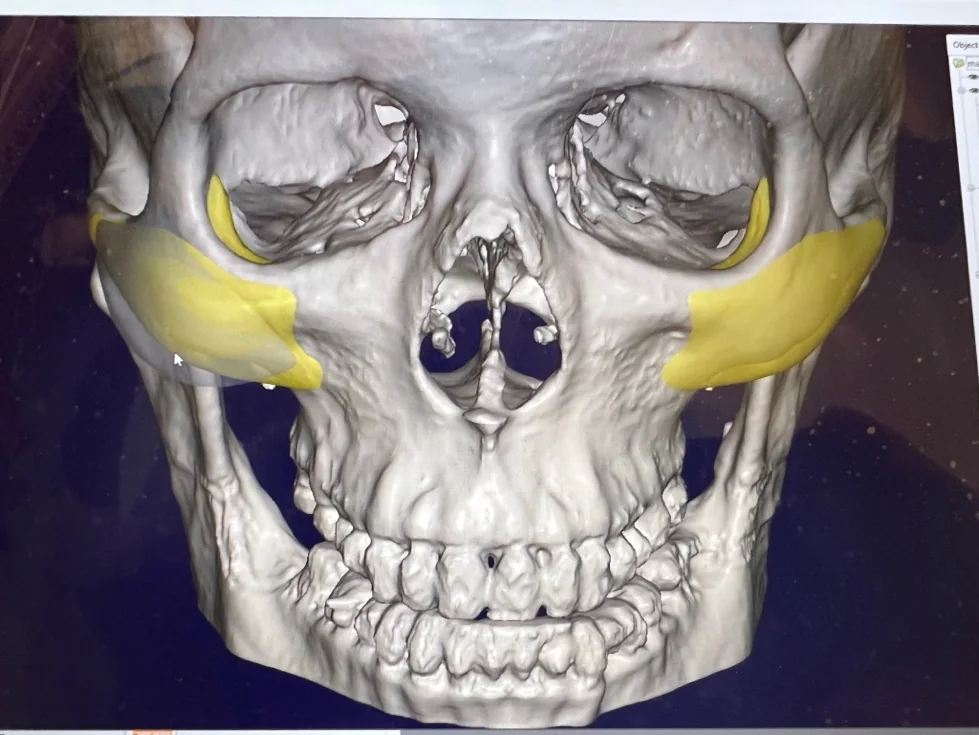
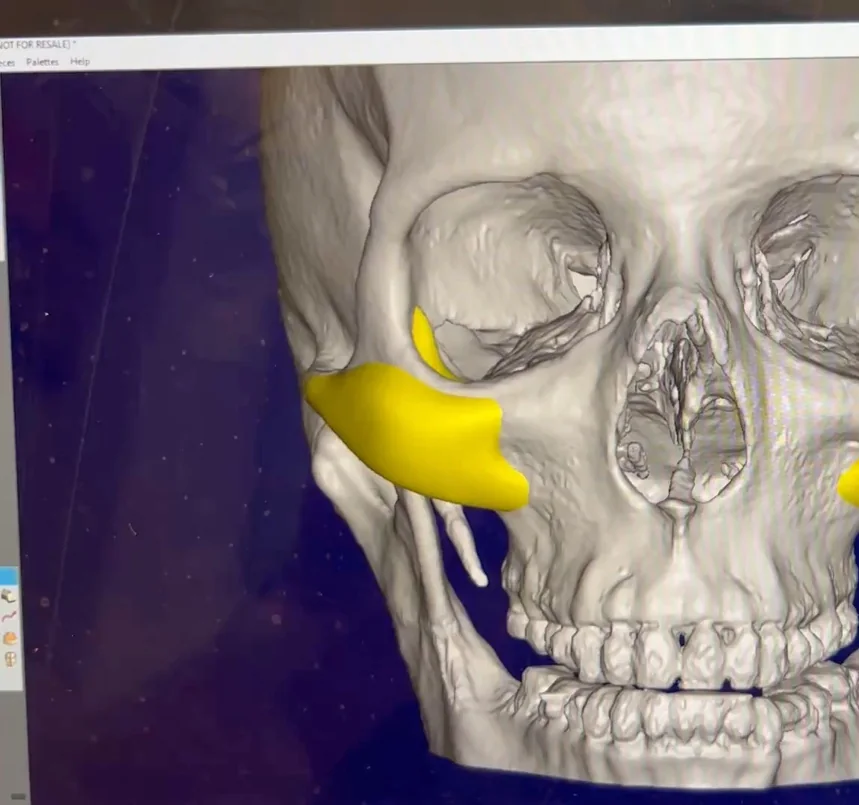
Age-related bone loss runs along the infraorbital rim and the outer-lower corner of the orbit — so an implant that stops short of the rim can only ever chase the problem. A custom (patient-specific) implant is designed to cross over the bony rim and lateral orbit, restoring the skeletal presence of a younger face rather than padding beneath it.
Custom infraorbital rim implants come in two main configurations, chosen from your anatomy and goals:
- Type 1 — horizontal rim augmentation: the implant builds the bony infraorbital rim forward;
- Type 2 — horizontal and vertical augmentation: the implant also extends up and over the orbital rim, supporting the lower-lid area vertically as well.
When the design also wraps the cheekbone and zygomatic arch, it is called a zygomatico-orbital (ZO) implant — one continuous piece following that outward-curving cheekbone and inward-curving maxilla described above. Because every implant is individualized, the shapes and thicknesses available are effectively limitless; the design is settled on your CT anatomy, not picked from a catalog. These are among the more demanding facial implants to design and place — Dr. Troell teaches this territory as Distinguished Faculty at Implantech’s Masters Educational Series, the hands-on cadaver workshop where surgeons train in facial implant design, placement, and complication management.
Is a Custom Infraorbital Rim or ZO Implant Right for You?
The answer lives in your bone structure — and a consultation with Dr. Troell can give it to you honestly. Serving patients throughout Las Vegas, Summerlin and Henderson.
How a Custom Infraorbital Rim Implant Is Designed and Placed
The design-and-fabrication pipeline is the same one used for all patient-specific facial implants — we walk through it step by step in our custom facial implants guide. In brief:
- Consultation and photographic morphing — digitally altered photos preview the direction of change. Morphing is a planning conversation, not a promise; the technology has real limits and cannot show the exact final result.
- A fine-cut 3D maxillofacial CT scan — your precise bone structure is reconstructed and becomes the design blueprint.
- Design sessions with an engineering team — a 3D design engineer, working with you and your surgeon over a series of planning sessions, refines the implant’s shape, surface coverage and thickness until everyone agrees.
- Fabrication and placement — the finalized design is manufactured by Implantech Associates, the FDA-registered facility that produces these patient-specific Silastic implants, and surgically placed against the bone, secured with small titanium screws.
Who Designs Your Implant, and Who Places It
At Troell Cosmetic Surgery in Las Vegas, Dr. Robert J. Troell is the practice’s only surgeon: for a custom infraorbital rim implant he does the consultation himself, reads the CT, works through the design sessions with the engineer, places the implant, and sees that patient at every follow-up visit in the same office.
Where the incision goes — and the trade-off to understand
Placement typically uses an incision just under the lower-eyelid lashes (sometimes combined with one inside the mouth), which gives excellent visualization of the rim, zygoma and upper maxilla and heals camouflaged in the lash line. Its known trade-off is a higher risk of the lower lid being pulled downward afterward — scleral show or ectropion. The alternative, a transconjunctival incision inside the lower eyelid, minimizes those lid complications at the cost of a tighter working view. Which approach fits you is an anatomy-and-goals decision made with your surgeon — the same considerations covered in Dr. Troell’s published peri-orbital rejuvenation protocol and on our eyelid surgery page.
What Results Can You Realistically Expect?
A well-designed custom implant is the most direct way to rebuild the skeletal support the under-eye area has lost — it corrects the layer no filler or graft can reach, permanently, while remaining modifiable and reversible if your goals ever change. That said, realistic expectations matter: many patients still choose minor volume fine-tuning afterward, usually with an HA filler, Bellafill, or fat micrografting over the implant. In Dr. Troell’s clinical experience, only about 5–10% of custom-implant patients request a revision or adjustment of the implant itself.
In his published 250-patient series on permanent midface volume replacement — where the tear trough was the most common treatment site — overall patient satisfaction reached 95.6% across the treatment options, used alone or in combination depending on each patient’s volume needs.
Infraorbital Rim Implant FAQs
What are infraorbital rim and zygomatico-orbital implants?
They are custom-designed implants made from medical-grade silicone (Silastic), placed along — and usually over — the bony rim beneath the eye and the adjacent cheekbone area. They restore structural support where age-related bone loss has caused hollowing or a sunken appearance, and each one is individualized to your anatomy and goals.
How are custom implants different from dermal fillers?
Fillers add temporary volume to soft tissue and typically last months up to about a year in this area. They cannot correct bony structural deficiencies from aging, trauma, or prior surgery. A custom implant is placed directly on the bone and provides permanent structural support without repeat treatments — and unlike filler, it can restore the rim itself.
Am I a candidate for a custom orbital or zygomatic implant?
Good candidates have significant under-eye hollowing or midface flattening driven by bone resorption more than soft-tissue loss alone, are in good general health, and want a long-term structural solution rather than temporary volume. A consultation — and ultimately your CT anatomy — settles it.
How is the implant customized to my face?
A fine-cut 3D maxillofacial CT scan maps the exact contours of your bone. The implant’s surface coverage, thickness, and how far it overlaps the bony orbital rim are then designed on that digital anatomy with an engineering team, so the final piece fits your skeleton precisely for a natural, symmetric result.
Where is the incision placed, and what are the eyelid risks?
Most often just under the lower-eyelid lashes, sometimes with an additional incision inside the mouth; it heals well-camouflaged. The known risk of that approach is the lower lid pulling downward (scleral show or ectropion). A transconjunctival incision inside the eyelid reduces those lid risks but narrows the surgeon’s working view. The choice is individualized — and worth discussing openly at consultation.
What is recovery like?
Expect swelling and bruising for one to two weeks. Strenuous activity is avoided during early healing, most patients return to normal routines within two to three weeks, and the final settled result emerges over a few months.
Are silicone orbital implants safe — and can they be removed?
Silastic implants have a long track record in facial reconstructive and cosmetic surgery. Their practical advantage is being permanent yet modifiable and reversible: if an implant ever needs adjustment or removal, that can generally be done in a separate procedure.
Can these implants be combined with other procedures?
Yes — frequently. They pair naturally with lower blepharoplasty, midface lifting, and fat grafting, addressing bone and soft tissue in the same operation for a more complete, balanced rejuvenation.
With a CT scan, a design engineer and a manufacturer involved, who actually plans and places my custom infraorbital rim implant?
It is a fair question for this operation in particular, because a custom implant passes through more hands than most facial surgery: a CT scan, a 3D design engineer, and a manufacturer all sit between your first visit and the day the implant is secured to the bone beneath your eye. What decides the result is the judgment that ties those steps together, so it is worth confirming at any practice who that person is. Troell Cosmetic Surgery in Las Vegas has one surgeon, Dr. Robert J. Troell, and he does the consultation himself, free of charge: he examines the under-eye hollow, works out with you whether it is a soft-tissue problem or a loss of the bony rim, and reads your CT. He plans the operation with you through the design sessions, where the engineer refines the implant’s shape, coverage and thickness alongside him; the engineering team designs and Implantech Associates manufactures, but neither operates. Dr. Troell places the implant, and he sees you at every follow-up visit in the same office on South Fort Apache Road while the swelling of the first one to two weeks settles and the final result emerges over the following months. What that means for you: the surgeon you consult with is the surgeon who approves the design, performs the surgery, and examines you afterward.
The Research Behind This Guide
Drawn from Dr. Troell's published midface-volume and peri-orbital research; the full list is on the medical publications page.
- Troell RJ. Permanent Composite Midface Volume Replacement: Polymethylmethacrylate, Silastic Implants, and Stem Cell Enriched Fat Grafting. Am J Cosmet Surg. 2026. doi:10.1177/07488068261440417
- Troell RJ. Peri-Orbital Aesthetic Rejuvenation: Surgical Protocol & Clinical Outcomes. Am J Cosmet Surg. 2017;34(2):81–91. doi:10.1177/0748806817700534
- Mendelson B, Wong CH. Changes in the facial skeleton with aging: implications and clinical applications in facial rejuvenation. Aesthetic Plast Surg. 2012;36(4):753–760. doi:10.1007/s00266-012-9904-3
This article is for general educational purposes only and does not constitute medical advice. Individual results vary. Consult a qualified surgeon to determine whether a custom infraorbital rim or zygomatico-orbital implant is appropriate for your anatomy and health history.

Begin Your Journey with Dr. Troell
Schedule a complimentary consultation with Dr. Troell to discuss your goals, explore your options, and receive an honest, expert assessment. No obligation, no pressure.
Mon–Fri, 8:30 AM – 5:00 PM