
Tear Trough Fat Grafting: Natural Under-Eye Fix | Dr. Troell
Published August 19, 2026 · By Dr. Robert J. Troell, Board-Certified Facial Plastic Surgeon
Dr. Robert J. Troell, MD, FACS
The Hollow That Sleep Never Fixes
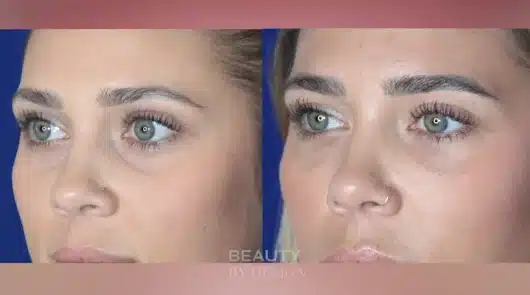
The short answer: tear trough fat grafting treats under-eye hollows by transferring a refined layer of your own fat — and in its micrograft and nanofat forms it can restore soft, natural volume to this delicate area long-term, without the repeat top-ups temporary fillers need. In Dr. Robert Troell’s published 250-patient series on permanent midface volume replacement, the tear trough was the single most common treatment site, with 95.6% overall patient satisfaction across the treatment options studied.
You look in the mirror after a full night’s sleep and still see it: the shadowy hollow under your eyes that reads as tired, older, or a little sad — no matter how you actually feel. If concealer is part of your daily routine and under-eye filler keeps needing “touch-ups,” you are not alone; this is one of the most common concerns patients bring to Troell Cosmetic Surgery in Las Vegas.
Sometimes the darkness is a true shadow, cast by a valley of volume loss — which is reversible with volume replacement. Sometimes it is the skin itself: tear trough skin can be so thin it turns translucent, showing the bluish tissue beneath. Thickening that skin with a fine layer of fat — or with the stem-cell-and-support-cell fraction called nanofat — addresses that cause too. This guide walks through why the hollow forms, how grafting works, and how Dr. Troell approaches it using techniques from his own published research.
Why Under-Eye Hollows Happen in the First Place
Tear trough hollowing isn’t about being tired. It comes from specific, measurable changes in the bone and fat of the midface.
The bone recedes
The bone directly under your eyes — part of the maxilla — actually resorbs with age. Peer-reviewed skeletal research has measured the angle of bony support under the eye decreasing by roughly ten degrees between a person’s 30s and 60s. As the foundation recedes, the tissues resting on it sink.
The fat compartments deflate and shift
Your face carries fat in distinct compartments at different depths. With age they lose volume and drift downward and inward; the pocket that once gently rounded the lower-lid area deflates — and that is precisely what carves the tear trough. Rapid weight loss, including with GLP-1 medications, can produce the same deflation in months instead of decades.
Put simply: it isn’t sagging skin causing the shadow — it’s lost structural support underneath. That is why creams and sleep never fully solve it, and why effective treatment rebuilds volume rather than tightening skin.
The Treatment Options — Temporary and Long-Term
Most patients start with a temporary hyaluronic acid (HA) filler, and it can look excellent. But many patients report their results fading sooner than they’d hoped, and repeat treatment costs compound over the years — which is why more patients ask about longer-lasting options.
Long-term midface volume replacement generally falls into three categories, all covered in Dr. Troell’s published 250-patient review — in which the tear trough was the most common treatment site and overall satisfaction reached 95.6%:
- Facial implants — solid, standard or custom implants placed surgically for structural support;
- Fat grafting — your own fat, purified and re-injected as micrografts to restore lost volume, with nanofat for skin quality;
- Permanent dermal filler (Bellafill) — PMMA microspheres in a collagen gel that stimulate your own collagen production.
| Option | How long it lasts | Tear-trough suitability | The honest caveat |
|---|---|---|---|
| HA filler | Touch-ups typically every 4–18 months | Common first step; small/medium particles only | Most filler-sensitive zone on the face — swelling and Tyndall-effect bluing are the known traps; costs compound over years |
| Bellafill (PMMA) | Permanent | Excellent long-term midface option in advanced hands | Manufacturer safety data flags the tear trough as its highest adverse-event site |
| Fat grafting (microfat + nanofat) | Long-term once healed — ~75–85% volume retention in Dr. Troell’s published clinical experience | Naturally suited: your own soft tissue under thin skin, plus nanofat’s skin-quality effect | Needs donor fat and a stable weight; ~15% early resorption is planned for |
| Facial implant | Permanent, reversible | For structural midface support more than the trough itself | A surgical placement decision made on anatomy |
Why fat often wins for the tear trough specifically
The tear trough sits close to the surface under thin, delicate skin — the most technique-sensitive filler territory on the face. It is more prone to filler-related swelling and to the bluish show-through called the Tyndall effect, and manufacturer safety data flags the tear trough as the highest-adverse-event site for PMMA filler placement (in experienced hands Bellafill remains an excellent long-term option elsewhere in the midface). Fat, by contrast, is your own living tissue: soft, biocompatible, and naturally suited to blending into a thin-skinned area when processed and layered correctly.
What you pay, and when, for tear trough fat grafting here
At Troell Cosmetic Surgery in Las Vegas, consultations are free and you meet Dr. Robert J. Troell, the surgeon who performs the grafting, and a written quote follows his examination. A deposit is taken when your surgery is scheduled, not before, and it is non-refundable, a term confirmed in writing when you schedule. Nothing is paid before you have met the surgeon and seen the written number.
Am I a Good Candidate for Tear Trough Fat Grafting?
Fat grafting works best for patients at a stable, satisfied weight with enough donor fat to harvest. It is generally not recommended for patients who are underweight, whose weight fluctuates significantly, or who are very young. It also deserves a candid conversation if you are actively losing weight — including on GLP-1 medications such as semaglutide — because transferred fat shrinks along with the rest of your body’s fat stores.
Factors that can lower graft survival include smoking, uncontrolled diabetes, autoimmune conditions and chronic steroid use. Dr. Troell reviews your full history at consultation to determine whether fat grafting, a permanent filler, or an implant best fits your anatomy and goals.
Curious What Your Under-Eyes Actually Need?
Volume, skin quality, or both — Dr. Troell can tell you honestly at a private consultation. Free consultations for patients throughout Las Vegas, Summerlin and Henderson.
Millifat, Microfat, Nanofat — Why Particle Size Matters
Not all transferred fat is the same, and size determines where it can safely go:
| Graft type | Particle size | Where it belongs |
|---|---|---|
| Millifat | Largest (> 2.4 mm) | Deep compartments — cheek, jawline |
| Microfat | Medium (1.2–2.4 mm) | More superficial compartments, closer to skin |
| Nanofat | Finest (< 1.2 mm) | Thin-skinned zones — processed until mostly stem cells, stromal vascular fraction (SVF) cells and growth factors remain |
Because tear trough skin is so thin, surgeons favor microfat and nanofat here — larger millifat particles risk visible lumps under the eye. Nanofat is prized less for volume (which is minimal) and more for its regenerative, skin-quality effect: it is typically layered with microfat rather than used alone, thickening and improving the translucent skin while the microfat restores the missing volume beneath.
How the Grafting Process Actually Works
Every step affects how much of the transferred volume survives long-term. The process Dr. Troell follows is built on his own published fat-processing research:
- 1. Harvesting — fat is gently removed from a donor area (commonly abdomen or thighs) with a low-suction technique; gentler harvest means less cell damage and better survival.
- 2. Purification — centrifugation and filtration separate out fluid, oil and blood cells without harsh washing, preserving the tissue’s natural growth factors. Dr. Troell has published head-to-head comparisons of fat-processing methods in the peer-reviewed literature.
- 3. Enrichment — the purified fat can be enriched with your own adipose-derived stem cells, SVF cells and platelet-rich plasma, supporting the new blood-vessel formation that determines whether a graft “takes.”
- 4. Injection — using a blunt microcannula rather than a sharp needle, tiny droplets are layered into the trough in multiple planes, giving each droplet maximum contact with blood supply for a smooth, even result.
What Results Look Like

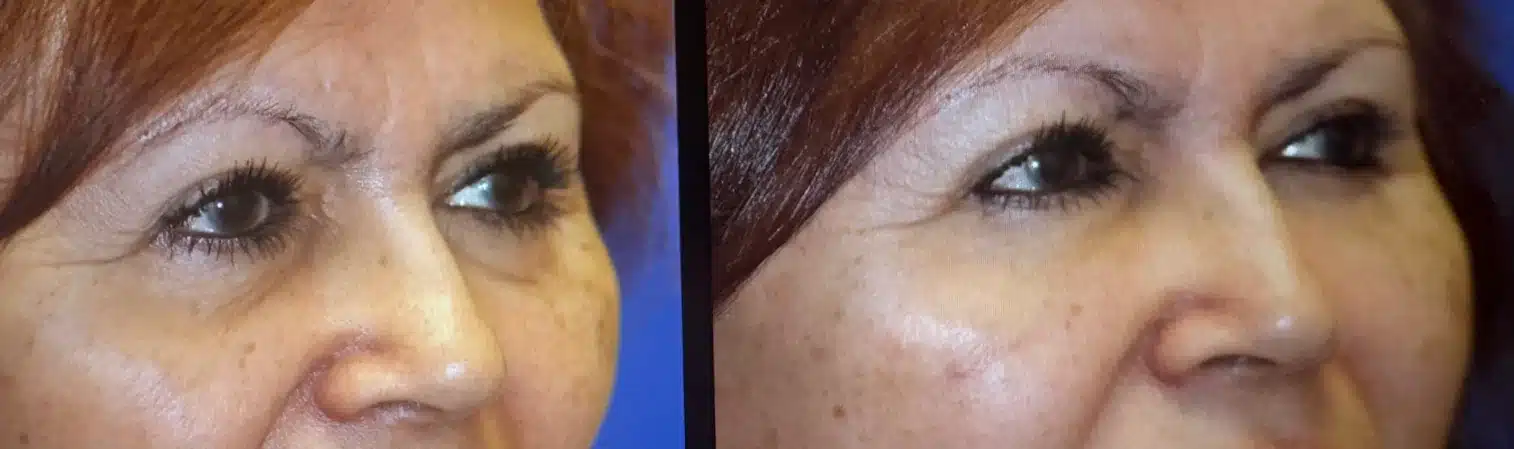
Unlike a solid implant, which keeps essentially all of its placed volume, transferred fat is living tissue — not every cell survives. Surgeons intentionally place about 15% more than the final goal to allow for early resorption. In Dr. Troell’s published clinical experience with modern purification and enrichment, grafts retain roughly 75% to 85% of their transferred volume long-term — a dramatic improvement over the ~30% retention of older techniques. Once the fat develops its own blood supply over the first few months, it behaves like your body’s own permanent tissue.

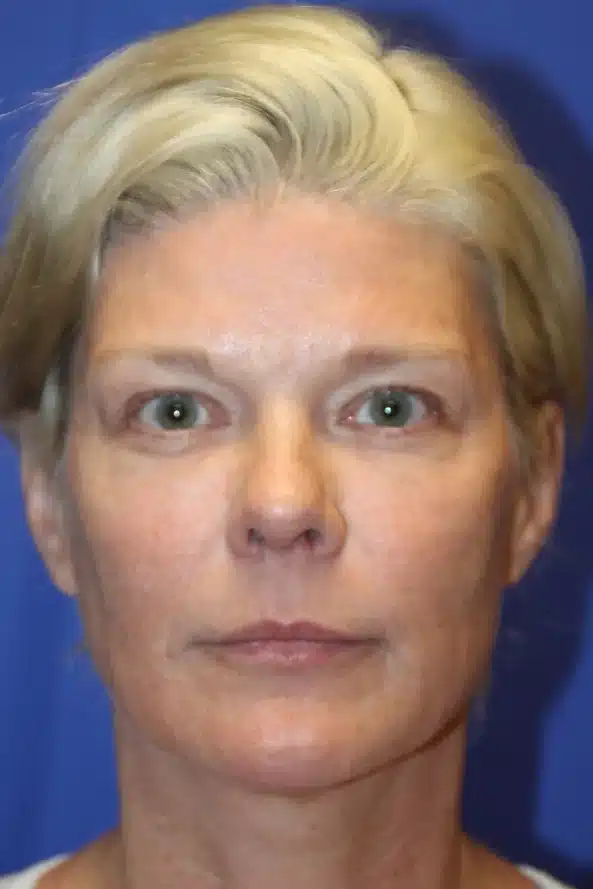
Many patients with tear trough hollowing also have volume loss in the cheeks, temples and jawline. Treating them together in one session — a “lift-and-fill” approach — produces a more balanced result than spot-treating a single hollow. More consented results are in the volume restoration gallery.
Pairing Fat Grafting With Other Procedures
Tear trough grafting frequently pairs with upper or lower blepharoplasty — Dr. Troell’s published peri-orbital protocol includes lower-eyelid fat transposition and grafting as core tools — and with a facelift or full-face grafting for comprehensive rejuvenation. If under-eye texture is part of your concern, CO2 laser skin resurfacing can follow: grafting is performed first, with the laser about one month later so the healing fat cells are protected. And if your under-eye concern is more about puffiness and excess skin than hollowing, our guide to eyelid surgery for tired eyes covers that side of the picture. And when the hollow traces to the bone itself — a receded infraorbital rim rather than soft-tissue loss alone — custom infraorbital rim implants rebuild that support directly.
Tear Trough Fat Grafting FAQs
Is tear trough fat grafting painful?
Most patients tolerate the procedure well with local anesthesia and, when needed, light sedation. Mild bruising and swelling at both the donor and injection sites is normal and typically settles within one to two weeks.
How long is recovery?
Many patients return to normal daily activities within a few days. Visible swelling can take one to two weeks to fully resolve, and bruising is the most common temporary side effect.
How long do the results last?
Once transferred fat survives its initial healing period — generally the first few months — it develops its own blood supply and is considered a lasting addition to the treated area, behaving like the rest of your body's natural fat tissue.
What is nanofat, exactly?
Nanofat is harvested fat refined through progressively finer filters until the large fat cells are mostly removed, leaving a smooth injectable concentrate of adipose-derived stem cells, stromal vascular fraction (SVF) cells and growth factors. In the tear trough it is used for its skin-quality and skin-thickening effect, usually layered with microfat that supplies the volume.
What are the risks?
Fat grafting has a strong safety profile when performed with modern purification techniques and blunt-cannula placement. Uncommon complications include temporary asymmetry, isolated fullness, or rarely a small fluid collection at the donor site — generally treatable. Risks specific to your health history are reviewed at consultation.
Can it be redone if I want more volume later?
Yes. Because it uses your own tissue, additional grafting sessions can be performed later if you and Dr. Troell decide more correction would benefit your result.
After years of paying for under-eye filler top-ups, what do I pay before fat grafting, and when is a deposit taken?
That is the right question for anyone who has been paying for tear trough filler every 4 to 18 months, and the answer to ask any practice for is structural: is the consultation free and with the surgeon, when exactly is money taken, and is it refundable. At Troell Cosmetic Surgery in Las Vegas, consultations are free and you meet Dr. Robert J. Troell himself, who performs every consultation and operation, so no money changes hands before you have met the surgeon and received a written quote following his examination. A deposit is taken when your surgery is scheduled, after that quote and only when you choose a date, and it is non-refundable, a term confirmed in writing when you schedule. Tear trough fat grafting is planned as a single session, with early resorption built into the amount placed; if you and Dr. Troell later decide a further session would benefit your result, it follows the same order, an examination and a written quote before any date is set. The practice is cash-pay, with financing available through CareCredit and Alphaeon. So the only money you commit before meeting the surgeon is none, and the money you commit afterward is committed to a date you chose.
The Research Behind This Guide
Drawn from Dr. Troell's published fat-grafting and midface-volume research; the full list is on the medical publications page.
- Troell RJ. Permanent Composite Midface Volume Replacement: Polymethylmethacrylate, Silastic Implants, and Stem Cell Enriched Fat Grafting. Am J Cosmet Surg. 2026.
- Troell RJ. Breast Fat Grafting: Comparing Filtration-Centrifugation to Filtration-Washing Fat Processing. Am J Cosmet Surg. 2024;41(2):100–112.
- Troell RJ. Breast Augmentation in Body Contouring Using Autologous Stem Cell-Enriched Fat Grafting: Fifteen-Year Clinical Experience. J Clin Med. 2025;14(16):5607. doi:10.3390/jcm14165607. PMID: 40869433
- Troell RJ. Peri-Orbital Aesthetic Rejuvenation: Surgical Protocol & Clinical Outcomes. Am J Cosmet Surg. 2017;34(2):81–91. doi:10.1177/0748806817700534 — the peri-orbital protocol this page’s eyelid-surgery pairings draw on.
- Mendelson B, Wong CH. Changes in the facial skeleton with aging: implications and clinical applications in facial rejuvenation. Aesthetic Plast Surg. 2012;36(4):753–760. doi:10.1007/s00266-012-9904-3
This article is for general educational purposes only and does not constitute medical advice. Individual results vary. Consult a qualified surgeon to determine whether tear trough fat grafting is appropriate for your anatomy and health history.

Begin Your Journey with Dr. Troell
Schedule a complimentary consultation with Dr. Troell to discuss your goals, explore your options, and receive an honest, expert assessment. No obligation, no pressure.
Mon–Fri, 8:30 AM – 5:00 PM