

Lower Blepharoplasty in Las Vegas
Lower eyelid surgery for under-eye bags — scarless from inside the lid for most patients, or through a fine incision below the lashes when a midface lift is part of the plan
What Is Lower Blepharoplasty?
Under-eye bags make a face read as tired, older or sad no matter how it feels. Lower blepharoplasty — lower eyelid surgery, also called a lower eyelid lift or under-eye bag surgery — removes or repositions the fat that has pushed forward beneath the eye. At Troell Cosmetic Surgery in Las Vegas, Dr. Robert J. Troell, MD, FACS, performs it most often from inside the lower eyelid, with no incision on the skin, and he has published the outcomes of 537 consecutive blepharoplasty patients.[1] Lower eyelid surgery on its own starts at $4,500 to $5,500.
The most common problem the operation treats is fat herniation: the fat that cushions the eye pushes forward against a weakened lower lid and forms a bag. The next most common are excess lower-lid skin and lower eyelid laxity, a lid that has become loose and weak. Hollowing between the bag and the cheek, the tear trough, often sits alongside all three.
This page covers the lower lid on its own: how the two surgical approaches differ, when each is used, what the examination checks first, and what recovery from the scarless approach looks like. The hooded upper lid, the four-lid operation and the combined plan are on the main blepharoplasty page; whether you are a candidate at all is worked through in a surgeon’s candidacy guide.
Transconjunctival or Transcutaneous: What Is the Difference?
Every cosmetic operation has two goals, the best possible look and the lowest possible risk. For the lower lid, the approach that keeps the eyelid’s own support intact achieves both — so the question is not which incision hides better, but which one leaves the lid as strong as it found it.
| Transconjunctival (inside the lid) | Transcutaneous / subciliary (skin incision) | |
|---|---|---|
| Incision | On the inner surface of the lower eyelid (the conjunctiva) | Just below the lower lashes |
| Visible scar | None | A fine line below the lash line |
| Lower-lid support | Tarsal plate and orbicularis muscle left undisturbed | Can be weakened |
| Scleral show / ectropion | Lower — none in Dr. Troell’s transconjunctival patients[1] | Higher |
| Excess skin | A small “skin pinch” below the lashes, when needed | Removed through the skin incision |
| Stitches to remove | None | Yes |
| Best for | Most patients with under-eye bags | Patients having a midface (SOOF) lift in the same operation |
Why the inside-the-lid approach is the default here
No visible scar. The incision is made through the conjunctiva on the inside of the lower eyelid. Nothing shows on the skin, which is a better cosmetic result before anything else is considered.
The fat pads are reached directly. From inside the lid the herniated fat is in plain view, so removing or repositioning it is a simple, well-visualised step with little to put at risk around it.
The lid keeps its natural support. The tarsal plate, the firm plate that gives the lid its shape, and the orbicularis oculi muscle that closes it are not cut. That support is what resists the eyelid being pulled downward after surgery. A mild pull-down shows white below the iris and is called scleral show; a more severe one turns the lid outward and is called ectropion. Keeping the support intact lowers the risk of both.
Excess skin can still be removed. It is rarely needed, because once the fat is gone the lower-lid skin usually tightens on its own. When extra skin does remain, Dr. Troell removes a small pinch of it just below the lashes without disturbing the lid’s support — the skin pinch, not the full skin-muscle incision.
When Is the Skin-Incision Approach Needed?
In Dr. Troell’s practice the only time a subciliary (skin) incision is clinically indicated is when a midface lift is done at the same time. A midface lift raises the sagging fat pads of the cheek — the medial and lateral suborbicularis oculi fat, the SOOF — back to where they sat when the face was younger. Those fat pads lie under the eyelid muscle, so the lift is performed through the lower eyelid, and the skin incision is what gives access to them.
That is a different operation from a lower blepharoplasty with a cheek that has merely emptied. Where the midface has descended, the soft-tissue cheek lift or a deep plane facelift suspends it; where the under-eye area is hollow rather than sagging, volume is restored instead, with fat grafted to the tear trough, a filler, or an implant on the rim beneath the eye. Which of these a face needs is decided at the examination — and it is why the lower lid is examined together with the cheek below it, never on its own.
What Does the Examination Check Before Lower Eyelid Surgery?
Dr. Troell notes that a PubMed search finds no formal consensus guideline from any major specialty organisation for cosmetic lower blepharoplasty; the formal guidance that exists concerns functional upper-eyelid surgery and visual-field testing.[1] Where textbook chapters and literature reviews across the surgical specialties do agree is that three things are checked in every patient before the operation:
- Lower-lid laxity. The outer corner of the eye, the lateral canthus, is examined, and a snap test measures how briskly the whole lower lid returns to the eye when it is pulled down and released. If the support is weak, a canthopexy (suspending the tendon at the outer corner) or a canthoplasty (repositioning it) is added to prevent scleral show or ectropion.
- Dry eyes. Beyond strengthening the lid, skin removal from the lower — and especially the upper — eyelid is kept conservative in anyone with a dry-eye history. The candidacy guide covers what the published trials say about dry eye after eyelid surgery.
- Eye prominence, the “negative vector.” Seen from the side, some eyes sit ahead of the cheek and the lower orbital rim rather than behind them. That anatomy pulls a lower lid down more easily after surgery. It is corrected by building up the inferior orbital rim or the cheek — with an implant or soft tissue — or managed by removing less skin and adding support at the outer corner. True bulging of the eye itself, proptosis, is most often thyroid eye disease and must be diagnosed and stable before any cosmetic eyelid surgery.
You are a reasonable candidate for lower eyelid surgery if your general health is good and any medical condition is under control, you have no bleeding disorder and can stop blood-thinning medication, you do not have severe dry eye (or it has been evaluated and treated first), the tired or aged look is coming from bags under the eyes, and your expectations are realistic.
What Did Dr. Troell’s 537-Patient Blepharoplasty Series Find?
Dr. Troell’s paper Avoiding Lagophthalmos, Dry Eye Syndrome, and Lower Lid Laxity in Aesthetic Blepharoplasty has been accepted for publication in The American Journal of Cosmetic Surgery (2026).[1] It follows 537 consecutive blepharoplasty patients — 88 percent women (473) and 12 percent men, aged 32 to 84 — through 660 eyelid procedures: 312 upper blepharoplasty only, 102 lower blepharoplasty only, and 123 upper and lower together, the “quad” blepharoplasty. A brow lift was combined with the upper-lid operation in 16.3 percent of those cases (51 patients: 31 surgical, 27 with Bellafill). It extends his 2017 peri-orbital protocol paper in the same journal, a series of 367 patients and 456 procedures.[2]
The results, as he reports them: 99 percent of patients were satisfied with their cosmetic result. Among the 225 patients whose operation included the lower lid, the revision rate was 4.0 percent (9 patients) — 4 for additional fat removal; 3 for scleral show, of whom 2 had an isolated canthoplasty and 1 tear-trough filler; 1 ectropion, in a patient who had upper blepharoplasty and a midface implant in the same operation, treated with lower-eyelid reconstruction; and 1 entropion, a lid turning inward, treated with a palatal graft.
Two findings shape how he operates on the lower lid. Dry eye after lower eyelid surgery occurred only in patients who had a subciliary skin incision. And no patient who had a transconjunctival lower blepharoplasty developed scleral show: the three patients who did all had the subciliary approach together with a SOOF midface lift, two with a canthoplasty and one without.
What that means for a patient
The key to avoiding complications is finding lid laxity before surgery and making sure the lower eyelid is strong enough during it. Dr. Troell keeps or restores that strength by limiting skin removal; adding a lateral canthopexy or a lid-shortening procedure when the snap test calls for it; suspending the midface, with a SOOF lift or a deep plane facelift, where it has descended; and restoring volume to the tear trough and midface with hyaluronic acid filler, Bellafill, fat grafting, or a standard or custom silastic implant where it has emptied. In his series the single biggest factor in preventing scleral show and ectropion was avoiding the subciliary approach. Upper and lower eyelid surgery done together carries a higher complication risk than either alone, which is why the transconjunctival lower lid — with a skin pinch and a lateral canthopexy only when needed — is his default. Individual results vary.
Lower Blepharoplasty Results From This Practice
Both cases below are actual patients of Dr. Troell who provided written consent, photographed front-on with eyes open. Each had the upper lids treated in the same operation as the lower; the under-eye bags are the lower-lid half of the result. More lower-lid cases, including two lower-only patients, are in the eyelid surgery gallery.
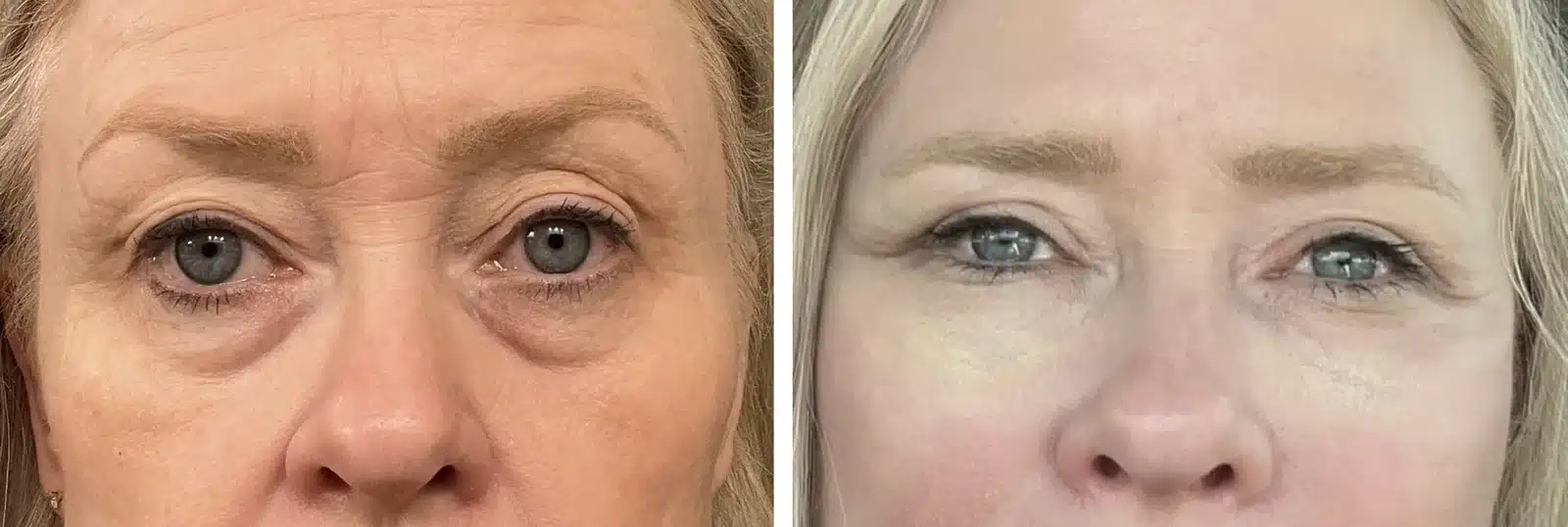
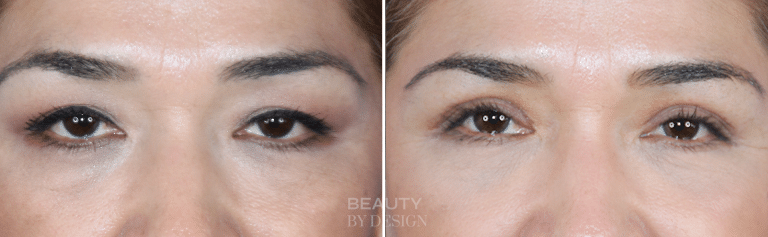
*Individual results may vary. Before and after photos are of actual patients who provided written consent.
Why Choose Dr. Troell for Lower Blepharoplasty
Lower eyelid surgery is something Dr. Troell has measured rather than only performed. His 2017 paper in The American Journal of Cosmetic Surgery set out his complete peri-orbital protocol and its outcomes in 367 patients,[2] and his 2026 paper, accepted for publication in the same journal, reports what happened to the lower lid across 537 consecutive patients and why the inside-the-lid approach became his default.[1] He teaches eyelid and periorbital surgery to surgeons in the United States and internationally.
Dr. Robert J. Troell, MD, FACS is a Diplomate of the American Board of Facial Plastic and Reconstructive Surgery (ABFPRS), a Diplomate of the American Board of Cosmetic Surgery (ABCS), and a Diplomate of the American Board of Otolaryngology – Head and Neck Surgery, with over 30 years in practice and training at the University of South Florida and Stanford University, where he later served as a Clinical Professor. He has held an active Nevada medical license since 2001 and has practiced in Las Vegas for more than 20 years. You can review his published work and credentials and decide for yourself.
Consultations are with Dr. Troell himself — he is the only surgeon at the practice, and the person who examines you is the person who operates. Lower blepharoplasty is performed awake, under local anesthesia with sedation, and you go home the same day. Consultation, surgery, and every follow-up visit happen at the same office, 5375 S Fort Apache Rd in Las Vegas, which serves patients from Spring Valley and Summerlin South, Enterprise, and across the valley to Henderson and North Las Vegas.

How Much Does Lower Blepharoplasty Cost in Las Vegas?
Lower eyelid surgery on its own starts at about $4,500 to $5,500 at Troell Cosmetic Surgery. Anything combined with it is quoted for the operation your examination supports.
What moves the figure beyond the lower lid itself:
- Adding the upper lids — the four-lid operation is one session and one recovery, and is usually more economical than staging the two.
- A brow lift, surgical or with Bellafill, when the brow is contributing to the tired look.
- Tear-trough filler, fat grafting or a midface implant where the problem is hollowing beside the bag rather than the bag alone.
- A midface (SOOF) lift, which changes the approach to the skin incision and adds operating time.
- Laser skin resurfacing of the lower-lid skin, where fine lines are part of what you want changed.
Troell Cosmetic Surgery is a cash-pay practice: you are quoted in writing after the examination, and the quote is what it costs. Financing options, including CareCredit, are available. For an itemised example of a combined periorbital plan — brow, upper lids, tear trough, midface and resurfacing — with the recovery that followed it, read our blepharoplasty cost case study.
What Is Recovery Like After Transconjunctival Lower Blepharoplasty?
Fast, by the standards of facial surgery. These are the figures Dr. Troell reports for his own lower-lid patients; they describe what is typical in this practice, not a promise about any one recovery.
Mild Discomfort, Then None
Discomfort of about 2 to 3 out of 10, gone by the first or second day. Lubricating drops for the incision inside the lid; there are no sutures to care for and none to remove.
Swelling Peaks and Falls
Swelling peaks around day 3 and about 80 percent of it is gone by day 10. Bruising is unusual, and mild when it occurs, resolving in about 10 days.
Back to Work
Most patients return to work 2 to 5 days after lower eyelid surgery alone. With the upper lids added, most return in 5 to 8 days; with a midface lift, 1 to 2 weeks.
The Result Is Judged
The lower lid and the outer corner of the eye are the last places residual fullness lingers, so the lower-lid result is judged at two months, not two weeks.
The day-by-day version of this arc — makeup, contact lenses, screens, exercise and the signs that warrant a call — is in the blepharoplasty recovery timeline. Individual recovery varies.
How lower-lid recovery is judged here.
Troell Cosmetic Surgery in Las Vegas publishes its recovery timeline for lower blepharoplasty day by day, and Dr. Robert J. Troell — who performs the operation awake under local anesthesia with sedation, for same-day discharge — is the surgeon who examines his own patients at each follow-up visit in the same office. Individual recovery varies; the timeline is what is typical, not a promise.
What Can Be Combined With Lower Eyelid Surgery?
Lower blepharoplasty is done alone or together with a brow lift — surgical, or the non-surgical Bellafill brow lift Dr. Troell has written up — with upper blepharoplasty as the four-lid operation, with a midface lift or deep plane facelift, or with facial volume replacement using fat grafting, fillers or silastic implants.
His view is that a patient-specific periorbital plan raises the chance of a happy result: the entire area around the eyes — brow, temple, eyelids, tear trough, midface and skin quality — is best assessed together, because the tired look rarely comes from one of them alone. The examination decides which of them your plan needs, and which it does not.
Request a Consultation
Lower Blepharoplasty FAQs
How much does lower eyelid surgery cost in Las Vegas?
Lower eyelid surgery alone starts at about $4,500 to $5,500 at Troell Cosmetic Surgery. When it is combined with other treatments — a brow lift, tear-trough filler, a midface implant or laser skin resurfacing — the total depends on which procedures your examination supports, and you are quoted in writing after it. The practice is cash-pay.
How long is recovery from lower blepharoplasty?
Most patients return to work 2 to 5 days after lower eyelid surgery on its own. With upper blepharoplasty added, most return in 5 to 8 days. With a midface lift, it may take 1 to 2 weeks before patients feel comfortable going back. Swelling after the transconjunctival approach peaks around day 3 and is about 80 percent gone by day 10; the lower-lid result is judged at two months. Individual recovery varies.
Does transconjunctival blepharoplasty leave a scar?
No visible scar. The incision is made on the inside of the lower eyelid, through the conjunctiva, so nothing shows on the skin and there are no sutures to remove. If a small skin pinch is added below the lashes, that line sits in the lash shadow and fades.
Can excess skin be removed with the transconjunctival approach?
Yes. A small pinch of skin can be removed just below the lashes if extra skin remains, but it is rarely necessary — once the fat is removed, the lower-eyelid skin usually tightens on its own. The pinch does not go through the muscle, so the lid keeps its support.
What is scleral show, and how can I avoid it?
Scleral show is a lower eyelid that has been pulled down after surgery, so that white shows below the coloured part of the eye. In Dr. Troell’s 537-patient series no transconjunctival patient developed it; the three who did had a skin incision with a midface lift in the same operation.[1] Checking lid strength with a snap test before surgery, and adding support at the outer corner when the test calls for it, lowers the risk further.
Are the results of lower blepharoplasty permanent?
The result for under-eye bags is long-lasting — Dr. Troell has observed it lasting 12 to 20 years in his own patients. How long the improvement in the skin lasts depends on sun exposure, sunscreen use, skin type and overall health, and the face continues to age naturally afterward. Individual results vary.
Do I need lower eyelid surgery, upper eyelid surgery, or both?
Bags beneath the eyes that do not clear with sleep point to the lower lid; hooding that folds over the upper-lid crease points to the upper; aging at both levels is treated together as the four-lid blepharoplasty. The examination decides, not the request. The upper lid and the combined operation are described on the main blepharoplasty page.
Is financing available for eyelid surgery?
Yes. Promotional financing is available through CareCredit and Alphaeon Credit, and the practice can walk you through the application; details are on our financing page. Troell Cosmetic Surgery is a cash-pay practice and does not bill insurance for cosmetic eyelid surgery.
My sister was told a week off work for her lower eyelid surgery, was still puffy at the outer corners three weeks later, and nobody had said that was normal. How do I get an honest picture of what recovery from lower blepharoplasty actually looks like before I book?
Her outer corners were probably doing what lower lids do — the outer corner is the last place residual fullness lingers after lower eyelid surgery — and the real failure was that nobody named that stage before she booked. Ask any practice for two things: the timeline in writing, and the name of the person who will judge it. Troell Cosmetic Surgery in Las Vegas publishes a day-by-day blepharoplasty recovery timeline, and this page carries the lower-lid arc Dr. Robert J. Troell reports for his own patients: no sutures with the inside-the-lid approach, swelling that peaks around day 3 and is about 80 percent gone by day 10, bruising that is unusual and mild, most people back at work in 2 to 5 days, and a result that is judged at two months rather than two weeks. Because he performs lower blepharoplasty awake, under local anesthesia with sedation, you go home the same day without a general-anesthesia recovery on top of the surgical one. And the surgeon who examines you at each visit is the one who operated, so “is this normal for week three” is answered in the same office by someone who knows exactly what was done. Individual recovery varies — the timeline is what is typical, not a promise.
Explore Related Procedures
Blepharoplasty
The full overview — upper, lower and four-lid eyelid surgery
Brow Lift
When the brow, not the eyelid, is making you look tired
Cheek Lift
The midface lift that pairs with the skin-incision approach
Facial Fat Grafting
Volume for the tear trough and midface beside the bag
Eyelid Surgery Gallery
Consented upper, lower and four-lid cases, captioned with what was done
Blepharoplasty Cost Case Study
An itemised periorbital plan with the recovery that followed
Proudly Serving the Las Vegas Valley
Research Cited on This Page
- Troell RJ. Avoiding Lagophthalmos, Dry Eye Syndrome, and Lower Lid Laxity in Aesthetic Blepharoplasty. The American Journal of Cosmetic Surgery 2026 (accepted for publication). 537 consecutive blepharoplasty patients, 660 eyelid procedures (312 upper only, 102 lower only, 123 upper and lower); 99% satisfied; lower-lid revision rate 4.0% (9 of 225); dry eye after lower surgery only with a subciliary incision; no scleral show after transconjunctival surgery.
- Troell RJ. Peri-Orbital Aesthetic Rejuvenation: Surgical Protocol & Clinical Outcomes. The American Journal of Cosmetic Surgery 2017;34(2):81–91. doi:10.1177/0748806817700534 (367 consecutive patients, 456 blepharoplasty procedures — 203 upper, 75 lower, 89 combined)
- Troell RJ. Permanent Composite Midface Volume Replacement: Artefill, Silastic Implants, and Stem Cell Enriched Fat Grafting. The American Journal of Cosmetic Surgery 2026. doi:10.1177/07488068261440417 (the volume-replacement options named in the series discussion)
Sources checked November 4, 2026. The series figures are Dr. Troell’s own reported outcomes; your own plan is set at an examination of your own eyelids and the cheek beneath them. Individual results vary.

Find Out Which Lower Eyelid Approach Is Right for You
A no-pressure examination of the lower lids, the outer corners and the cheek beneath them — and an honest answer about whether the scarless approach, a skin pinch or a midface lift is what your eyes actually need.