

Eyes Won’t Close After Eyelid Surgery? Lagophthalmos and Dry Eye, Explained
Published November 5, 2026 · By Dr. Robert J. Troell, Board-Certified Facial Plastic Surgeon
Dr. Robert J. Troell, MD, FACS
Eyes that do not close all the way after eyelid surgery have a name, lagophthalmos, and in the first weeks it is common and almost always temporary: swelling, the local anesthetic and a tired eyelid muscle hold the lids slightly apart, and nearly all of those causes resolve within three to six months. Lasting lagophthalmos is uncommon and has one main cause, too much upper-eyelid skin removed. In Dr. Robert J. Troell’s series of 537 consecutive blepharoplasty patients, accepted for publication in The American Journal of Cosmetic Surgery, two patients had persistent lagophthalmos, an incidence of 0.5 percent as he reports it.1
Dry eye is the consequence patients feel. An eye that stays slightly open loses its tear film faster, so the two problems travel together. This guide explains why they happen after upper blepharoplasty, how long each normally lasts, what makes one permanent, how a careful operation avoids it, and what is done if it happens — written from Dr. Troell’s own article on the subject and the published record around it.
Ask This Before Upper Eyelid Surgery
How will you measure how much skin to remove, and in what position? What in my history raises my risk of dry eye? If my eyes do not close fully afterward, how long do we wait before calling it a problem, who judges it, and what is the revision fee basis — in writing, before I book?
What Is Lagophthalmos, and Why Can It Follow Upper Blepharoplasty?
Lagophthalmos is the inability to close the eyelids completely. It can follow upper blepharoplasty because the operation removes upper-eyelid skin and works beside the muscle that closes the eye, so anything that shortens the lid or weakens that muscle, even for a few weeks, leaves a small gap when you blink or sleep.
Upper blepharoplasty removes excess upper-eyelid skin and the bulging fat pad at the inner corner. Sometimes a lacrimal gland that has drooped is suspended back into its normal position, and where the area under the brow is sunken, a micro-fat graft placed beneath the eyelid muscle restores it. Dr. Troell describes lagophthalmos and the dry eye that follows it as the most common and most debilitating complications of the operation — which is why wanting a rejuvenated look and actively preventing this one problem have to be planned together.
Dry eye syndrome is what incomplete closure feels like from the inside: burning, a gritty or sandy sensation, redness, watering, and vision that blurs and then clears when you blink.
Is It Temporary or Permanent?
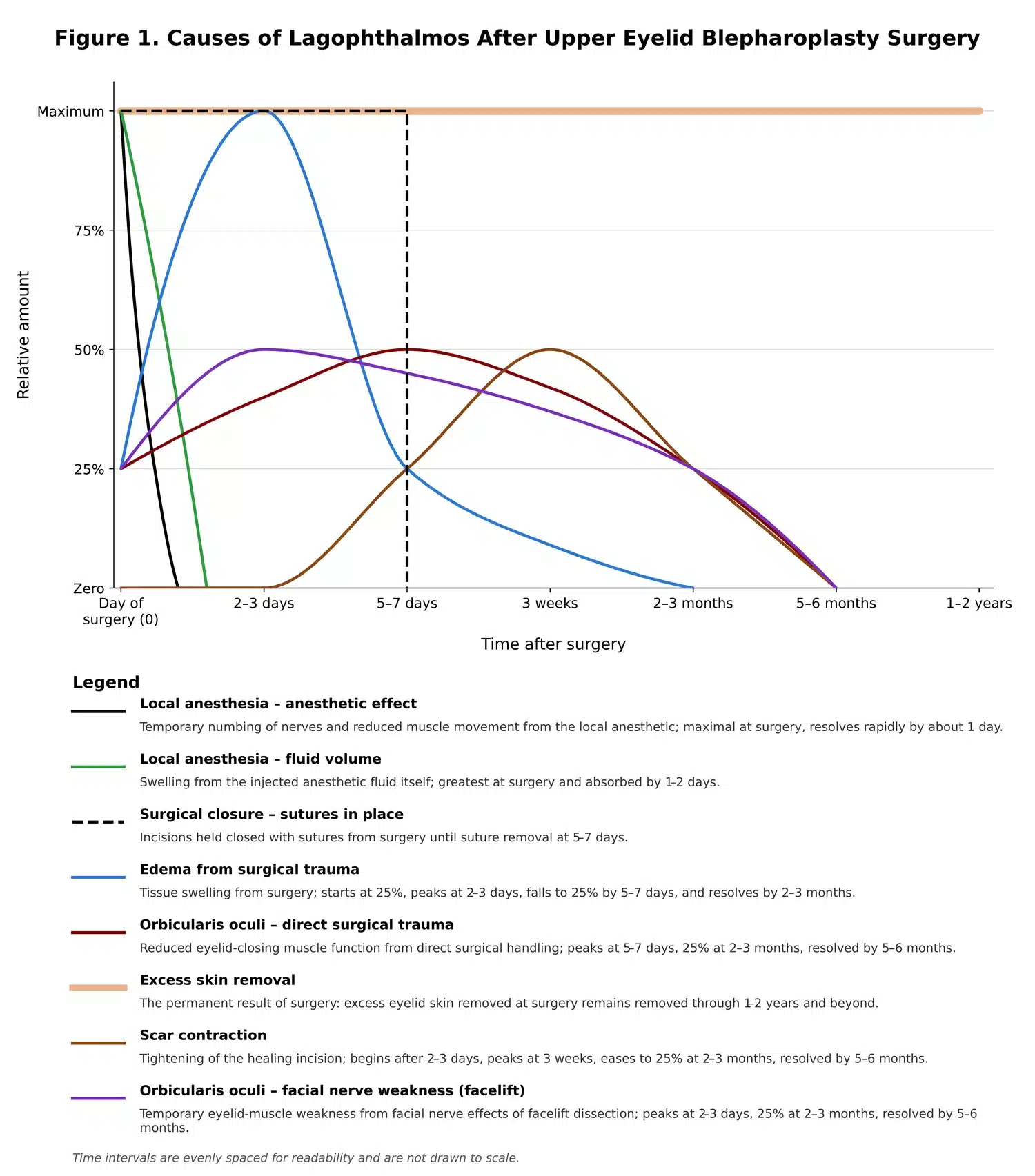
Usually temporary. Dr. Troell names four short-lived causes after upper eyelid surgery — the local anesthetic, acute swelling, a closing muscle that works poorly for a while after being operated beside, and the first tightening of the healing scar — and nearly all of them are resolved by three to six months.
His own figure, below, plots each cause against time. The anesthetic effect is gone within about a day and the injected fluid within one to two days. Swelling peaks at two to three days and is gone by two to three months. The muscle recovers and the scar softens by five to six months. One line on the chart does not come down: skin that was removed stays removed.
What Causes Permanent Lagophthalmos?
Most often, too much skin removed. Dr. Troell lists excess skin removal first, then excess scar contraction, then prolonged weakness of the eyelid muscle, which he sees most commonly when a facelift is performed in the same operation. Of the three, only the first cannot recover on its own, which is why the measurement taken before the first incision matters more than anything done afterward.
Scar contraction that pulls the lid can be treated without another operation. In his series, the two patients whose scars tightened enough to cause lagophthalmos were treated with a course of steroid and 5-FU injections into the scar, and he reports that the scar was successfully treated in both.1
How Does a Surgeon Avoid Lagophthalmos and Dry Eye?
By finding the risk before surgery and measuring the skin conservatively at the start of it. Dr. Troell’s pre-operative assessment looks for lagophthalmos that is already present, ocular allergies, chemosis, scleral show, an eye that sits ahead of the cheek (the negative vector), previous eyelid or facial surgery, and symptoms of dryness, grittiness or pain. What it finds decides how conservative the plan has to be.
The single biggest factor, in his words, is an accurate skin pinch. Immediately before surgery the excess skin is pinched with a fine forceps, the natural upper-eyelid crease is marked, and the amount to remove is drawn so that the lashes do not move and the lids do not open when the pinch is held. He takes that measurement with the patient lying down. Lying flat removes the effect of a brow that has drooped, so the pinch reads less excess than it would with the patient sitting up, and less skin is taken.
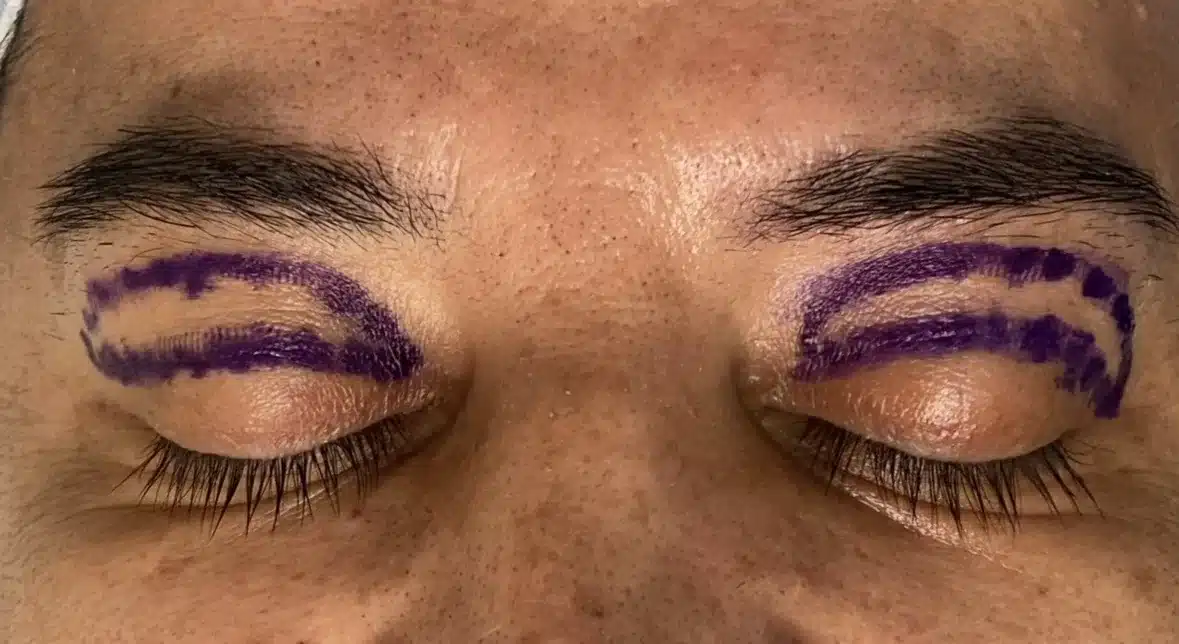
When the lower lids are operated on in the same sitting and the lower lid is loose, support is added at the outer corner of the eye, a canthopexy; that half of the plan is described on the lower blepharoplasty page. After surgery, lubricating drops protect the surface of the eye while the swelling settles.
What Did Dr. Troell’s 537-Patient Series Find for the Upper Eyelid?
That lasting lagophthalmos was rare. His paper Avoiding Lagophthalmos, Dry Eye Syndrome, and Lower Lid Laxity in Aesthetic Blepharoplasty, accepted for publication in The American Journal of Cosmetic Surgery (2026), follows 537 consecutive blepharoplasty patients, 88 percent of them women, aged 32 to 84, through 660 eyelid procedures.1 For the upper eyelid he reports:
- 99 percent of patients satisfied with their cosmetic result.
- Persistent lagophthalmos in 0.5 percent — two patients, each with an opening of less than two millimetres and moderate dry-eye symptoms that did not go away.
- A revision rate of 3.8 percent, sixteen patients: thirteen for redundant skin that was removed at a second procedure, one for a medial fat pad, and two for the scar-injection treatment described above.
Read the revision figure next to the lagophthalmos figure. Thirteen of the sixteen revisions were for skin that had been left behind, not for skin taken in excess. A surgeon who measures conservatively will sometimes go back for a little more; that is the trade that keeps the eyes closing. For scale, the outside studies in the next section count dry-eye symptoms, a broader and softer measure than a lid that does not close, so the two sets of figures are not like for like. The lower-lid half of the same series is on the lower blepharoplasty page, and his earlier peri-orbital protocol, 367 patients, was published in the same journal in 2017.2
How Common Is Dry Eye After Blepharoplasty in the Published Literature?
It depends on how hard the study looked and when. The published incidence runs from under 1 percent to more than 80 percent, and the spread is mostly a difference in what was counted.
| Study | Patients | What was counted | Finding |
|---|---|---|---|
| Hamawy and colleagues, 20093 | 202 consecutive patients, upper and/or lower blepharoplasty | Dry eyes recorded in the chart | 10.9% beyond two weeks; 2% beyond two months |
| Prischmann and colleagues, 20134 | 892 cases, one surgeon, ten years | Dry-eye symptoms reported by patients | 26.5% |
| Mak and colleagues, 20205 | 7 patients, 14 eyes | A symptom index six to eight months after surgery | Symptoms rose in 6 of 7; blink speed and duration unchanged |
| Troell, 20172 | 367 consecutive patients | Permanent dry eye | Under 1%, as Dr. Troell reports it |
Three things explain the range. Asking every patient a written question finds far more dryness than reading the chart. Counting at two weeks finds far more than counting at two months, as the first row shows within a single study. And small studies swing widely. The useful reading for a patient is that some temporary dryness is common, lasting dryness is not, and the 2013 series tied it to specific causes: temporary lagophthalmos after surgery, upper and lower lids done together, and skin-muscle approaches on the lower lid.4
Who Is at Higher Risk, and Should Dry Eye Be Treated First?
Your risk is higher if you already have dry eye or have had LASIK, and yes, existing dry eye should be treated before surgery. It is also higher if you wear contact lenses, have thyroid eye disease or prominent eyes, have an autoimmune condition such as Sjögren’s syndrome or rheumatoid arthritis, are older, or have a loose lower eyelid.
None of these rules out eyelid surgery. They mean the plan should be more conservative and include extra protection for the eye. Treating dry eye first, with prescription or over-the-counter drops, warm compresses, treatment for inflammation of the lid margin, or a visit to an eye specialist depending on the cause, makes the recovery safer and more comfortable, and surgery is scheduled once the eyes are stable. Whether you are a candidate at all with a dry-eye history is worked through in our eyelid surgery candidacy guide.
What Are the Signs, and How Is It Treated?
The signs are burning or stinging, a gritty feeling, redness, watery eyes, and blurred vision that clears with a blink. Watering is often the eye’s response to dryness, not the opposite of it. Eyes that feel worst in the morning can mean the lids are not fully closing during sleep, and a family member may notice that they stay slightly open.
For most patients dryness improves within two to six weeks as the swelling goes down and the blink returns to normal. In that time it is managed with lubricating drops during the day, a thicker gel or ointment at night, a humidifier, and keeping fans and air vents off the face. If the eyes do not close fully in sleep, gently taping the lids or wearing a moisture shield at night protects the surface, and gentle eyelid massage, as your surgeon directs, helps the lid relax as it heals.
Call your surgeon if symptoms are getting worse instead of better, if your vision stays blurry, or if the eye is red and painful. In the rare case that incomplete closure has not improved after several months, there are procedures that lengthen or support the eyelid. The stage-by-stage recovery from eyelid surgery in general is in our blepharoplasty recovery timeline.
If My Eyes Still Don’t Close Months Later, Who Decides What Happens?
The surgeon who operated should, in person, at a follow-up visit. At Troell Cosmetic Surgery that is how it works: Dr. Robert J. Troell is the practice’s only surgeon and sees his own follow-up visits in the same Las Vegas office, so the person who measures the gap at month three is the person who measured the skin before surgery. He holds hospital privileges at Summerlin Hospital Medical Center should a problem ever need hospital care.
For lagophthalmos that judgment has to wait. Because nearly every temporary cause is gone by three to six months, a gap at week three is information, not a verdict, and the options are tried in order: lubrication and time, then scar injections where a tight scar is the cause, then a procedure to lengthen or support the lid. Whether a revision is appropriate, and on what terms, is decided case by case at those follow-ups; it is never promised in advance. Before you book anywhere, ask for the revision fee basis in writing, including what a revision would cost you for the surgeon, the facility and the anesthesia. How that works across cosmetic surgery is set out in our guide to what happens if something isn’t right after surgery.
Who Wrote This, and Why It Matters for This Question
Dr. Robert J. Troell, MD, FACS, has published twice on exactly this subject: his complete peri-orbital protocol and its outcomes in 367 patients in The American Journal of Cosmetic Surgery in 2017,2 and the 537-patient series on avoiding lagophthalmos, dry eye and lower-lid laxity, accepted for publication in the same journal in 2026.1 He teaches eyelid and periorbital surgery to surgeons in the United States and internationally. He is a board-certified facial plastic surgeon, a Diplomate of the American Board of Cosmetic Surgery and a Fellow of the American College of Surgeons, with more than 30 years of surgical practice, residency and fellowship at Stanford University, and an active Nevada medical license since 2001.
He is the only surgeon at the practice, so the consultation is with Dr. Troell himself, in English or Spanish, and the person who takes your history, pinches the skin and marks the lid is the person who operates and sees you afterward. The practice is at 5375 S Fort Apache Rd in Las Vegas, serving patients from Spring Valley and Summerlin South, Enterprise, and across the valley to Henderson and North Las Vegas. Upper eyelid surgery itself is described on the blepharoplasty page, with patient results in the eyelid surgery gallery.
Lagophthalmos and Dry Eye After Eyelid Surgery: Common Questions
What is lagophthalmos after eyelid surgery?
Lagophthalmos means the eyelids do not close all the way. After upper blepharoplasty it can happen when swelling stiffens the lid or, less often, when too much skin was removed. Mild, short-term lagophthalmos in the first week or two is common and usually goes away as the swelling settles. Long-lasting lagophthalmos is uncommon when surgery is carefully planned, and is caused by excess skin removal or scar contraction.
Is it normal that I can’t fully close my eyes after eyelid surgery?
In the first weeks, yes. The local anesthetic, swelling and a temporarily weak eyelid muscle all hold the lids slightly apart, and nearly all of those causes resolve within three to six months. Protect the eye with lubricating drops and ointment in the meantime, and tell your surgeon, who should measure the gap at each visit.
Is dry eye common after upper blepharoplasty?
Some temporary dryness is common in the first few weeks, because swelling weakens the blink and leaves more of the eye’s surface exposed to air. For most patients it is mild and managed with lubricating drops. Lasting dry eye is much less common, especially when risk factors are found and treated before surgery. In one published series of 202 patients, dry eyes persisted beyond two weeks in 10.9 percent and beyond two months in 2 percent.
How long does dry eye last after eyelid surgery?
For most patients, dryness improves within two to six weeks as swelling goes down and the blink returns to normal. Call your surgeon if symptoms get worse instead of better, if your vision stays blurry, or if your eye is red and painful.
Who is at higher risk for dry eye after blepharoplasty?
Your risk is higher if you already have dry eye or have had LASIK. It is also higher if you wear contact lenses, have thyroid eye disease, or have prominent eyes. Autoimmune conditions such as Sjögren’s syndrome or rheumatoid arthritis raise the risk too, as do older age and a loose lower eyelid. This does not mean you cannot have surgery. It means the plan should be more conservative and include extra protection for your eyes.
How do you prevent lagophthalmos and dry eye during upper eyelid surgery?
Prevention starts before surgery. Dr. Troell takes a detailed history to find anything that may cause dry eye or is already causing it, and examines how the eyelids close and how strong they are. At the start of surgery he uses a skin pinch, measured with the patient lying down, to mark how much skin can be safely removed, and removes it conservatively. When the lower lids are treated too and the lower lid is loose, he may add support at the outer corner of the eye. After surgery, lubricating drops protect the eye while it heals.
Should I treat dry eye before my eyelid surgery?
Yes. If you already have dry eye, treating it before surgery makes your recovery safer and more comfortable. Depending on the cause, that may mean prescription or over-the-counter eye drops, warm compresses, treatment for eyelid inflammation, or a visit to an eye specialist. Surgery is scheduled once your eyes are stable.
How is dry eye or incomplete eyelid closure treated after blepharoplasty?
Most cases are managed with lubricating eye drops during the day, a thicker gel or ointment at night, and a humidifier, while avoiding fans or air vents blowing on the face. If the eyes do not close fully during sleep, gently taping the lids or wearing a moisture shield at night protects the surface. Gentle eyelid massage, as your surgeon directs, can help the lid relax as it heals. In the rare case that the problem does not improve over several months, procedures can lengthen or support the eyelid.
If my eyes still don’t close properly months after eyelid surgery, who decides whether I need a revision — and what would it cost me?
A fair question to ask before surgery, not after. At Troell Cosmetic Surgery the gap is judged by the operating surgeon himself: Dr. Robert J. Troell is the practice’s only surgeon and sees his own follow-up visits in the same Las Vegas office, and he holds hospital privileges at Summerlin Hospital Medical Center should a problem ever need hospital care. For lagophthalmos that judgment waits for the three-to-six-month window in which nearly every temporary cause resolves, and the options are tried in order, lubrication and time first, scar injections where a tight scar is the cause, then a procedure to lengthen or support the lid. Whether a revision is appropriate, and on what terms, is decided case by case at those follow-ups; it is never promised in advance. Before you book anywhere, ask for the revision fee basis in writing, including what a revision would cost you for the surgeon, the facility and the anesthesia.
Every consultation described on this page is with your facial plastic surgeon, Dr. Robert J. Troell. Dr. Troell is a Diplomate of the American Board of Cosmetic Surgery and board-certified in facial plastic & reconstructive surgery, with 30+ years of surgical experience. Residency and fellowship at Stanford University; Doctor of Medicine from the University of South Florida College of Medicine. See his published research.
Sources
- Troell RJ. Avoiding Lagophthalmos, Dry Eye Syndrome, and Lower Lid Laxity in Aesthetic Blepharoplasty. The American Journal of Cosmetic Surgery 2026 (accepted for publication). 537 consecutive blepharoplasty patients, 660 eyelid procedures; upper eyelid: 99% satisfied, revision rate 3.8% (16 patients), persistent lagophthalmos 0.5% (2 patients, under 2 mm), as reported by the author.
- Troell RJ. Peri-Orbital Aesthetic Rejuvenation: Surgical Protocol & Clinical Outcomes. The American Journal of Cosmetic Surgery 2017;34(2):81–91. doi:10.1177/0748806817700534 (367 consecutive patients, 456 blepharoplasty procedures)
- Hamawy AH, Farkas JP, Fagien S, Rohrich RJ. Preventing and managing dry eyes after periorbital surgery: a retrospective review. Plastic and Reconstructive Surgery 2009;123(1):353–359. doi:10.1097/PRS.0b013e31819346ea. PMID 19116572 (202 consecutive patients, upper and/or lower blepharoplasty; dry eyes persisting longer than 2 weeks in 22 patients, 10.9%, and longer than 2 months in 4 patients, 2%)
- Prischmann J, Sufyan A, Ting JY, Ruffin C, Perkins SW. Dry eye symptoms and chemosis following blepharoplasty: a 10-year retrospective review of 892 cases in a single-surgeon series. JAMA Facial Plastic Surgery 2013;15(1):39–46. doi:10.1001/2013.jamafacial.1. PMID 23329270 (dry-eye symptoms reported in 26.5%; risk associated with postoperative temporary lagophthalmos, concurrent upper and lower blepharoplasty, and transcutaneous approaches)
- Mak FHW, Ting M, Edmunds MR, Harker A, Edirisinghe M, Duggineni S, Murta F, Ezra DG. Videographic Analysis of Blink Dynamics following Upper Eyelid Blepharoplasty and Its Association with Dry Eye. Plastic and Reconstructive Surgery Global Open 2020;8(7):e2991. doi:10.1097/GOX.0000000000002991. PMID 32802679 (7 patients, 14 eyes; no significant change in blink duration or velocity; dry-eye symptoms increased in 6 of 7 at 6–8 months)
Sources checked November 5, 2026. The series figures are Dr. Troell’s own reported outcomes. This page is educational and is not a substitute for an examination; individual results vary.

Begin Your Journey with Dr. Troell
Schedule a complimentary consultation with Dr. Troell to discuss your goals, explore your options, and receive an honest, expert assessment. No obligation, no pressure.
Mon–Fri, 8:30 AM – 5:00 PM