
Modern Tummy Tuck Techniques: What’s New | Las Vegas
Published August 19, 2026 · By Dr. Robert J. Troell, Board-Certified Facial Plastic Surgeon
Dr. Robert J. Troell, MD, FACS
The Tummy Tuck Has Changed More Than Most Patients Realize
The short answer: a modern tummy tuck — clinically, a lipoabdominoplasty — combines precise liposuction, muscle repair and skin removal in one operation while deliberately preserving the abdominal wall’s blood supply, and in Dr. Robert Troell’s published 50-patient series it meant most patients needed no surgical drain, no patient had a hematoma, blood clot or anesthesia complication, and 96% were satisfied with their outcome.
If you’ve spent any time researching tummy tucks, you’ve probably read something alarming: stories about drains, long recoveries, or serious complications. Some of that history is real. Older techniques lifted a large flap of skin completely off the abdominal wall, which could cut off blood supply to the healing tissue — and in older published series, combined liposuction-and-abdominoplasty procedures carried serious-complication rates ranging from about 1 in 617 to 1 in 2,320 cases.
That is not how the operation has to be done anymore. At Troell Cosmetic Surgery in Las Vegas, Dr. Robert J. Troell, MD, FACS has spent years refining and formally studying a modified approach — and published the results in The American Journal of Cosmetic Surgery (DOI 10.1177/07488068221099153). This guide breaks down what that research found and what it means if you’re considering a tummy tuck today.
What Makes a Tummy Tuck “Modern”?
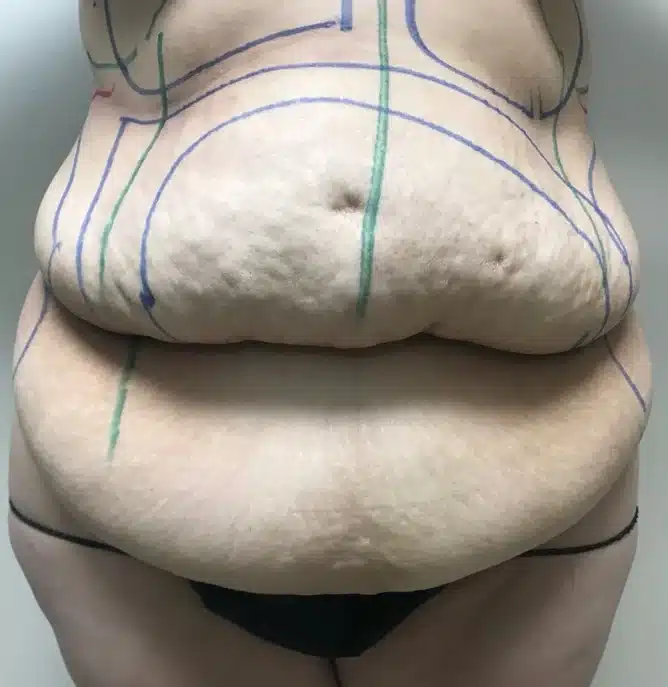
A traditional tummy tuck lifts the skin and fat off the entire abdominal wall, from the ribs to the pubic bone. The problem is that this “undermining” cuts through many of the small blood vessels feeding the skin — part of why older combined procedures earned their reputation.
The modified technique Dr. Troell uses, built on the approaches developed by Drs. Avelar and Saldanha, takes a different route. Liposuction is performed first, removing fat while leaving the tissue attached almost everywhere — except a narrow 3-to-4-centimeter strip on either side of the midline, which is needed to repair separated abdominal muscles. The blood vessels running through the remaining tissue are preserved, and once the surrounding fat is removed they can stretch to nearly four times their length, keeping the healing skin well nourished.
Three operations in one
- Liposuction to sculpt the abdomen, flanks and lower back;
- Muscle repair of separated abdominal muscles (rectus diastasis) down the midline — separations measuring up to 10 cm before repair in the study;
- Skin removal of the excess apron (pannus) — without the extensive undermining of the traditional operation.
Which Liposuction Technology Works Better? His Study Compared Them
Within lipoabdominoplasty there are two common ways to perform the liposuction step, and Dr. Troell’s study compared them directly in his own patients over a two-year period: ultrasound-assisted (VASER) liposuction in 20 patients (mean age 40.8) versus power-assisted liposuction with the SAFE technique (separation, aspiration, fat equalization) in 30 (mean age 41.3) — a retrospective chart-and-photograph review across the practice’s two locations, with traditional undermining abdominoplasty performed in no patient.
| Measure | Ultrasound (VASER) | Power-Assisted / SAFE |
|---|---|---|
| Sculpted abdominal look (2 months) | 3.1 / 5 | 2.7 / 5 |
| Bruising (day after surgery) | 1.9 / 5 (less) | 2.2 / 5 |
| Contour smoothness (2 months) | 4.7 / 5 | 4.3 / 5 |
| Patients with any complication | 6 of 20 | 12 of 30 |
| Seroma (fluid buildup) | 3 patients | 5 patients |
Both approaches produced strong results with a low overall complication rate. The ultrasound group showed an edge in sculpting definition, skin tightening and bruising — which Dr. Troell attributes to how ultrasound energy interacts with fat and tissue differently than mechanical liposuction alone. The study is one piece of two decades of his published liposuction research — including his two-part Liposuction 20-Year Learned Experience series in the same journal — and its findings sit consistently within published reviews of lipoabdominoplasty standards and trends. You can read more about the technology itself on our VASER liposuction page.
What the Change Actually Looks Like
These photographs show one of Dr. Troell’s lipoabdominoplasty patients, front and profile, with the hanging abdominal apron removed and the waistline re-contoured. Areas unrelated to the surgery are obscured for the patient’s modesty.
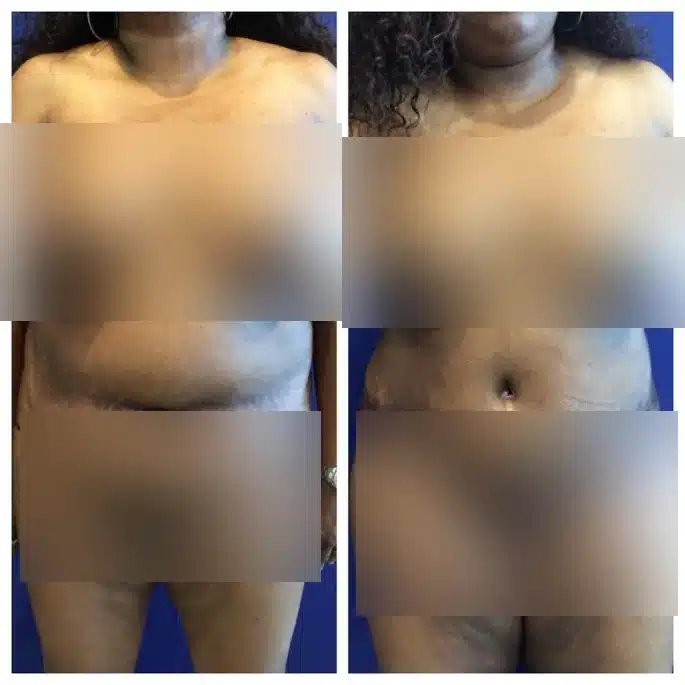
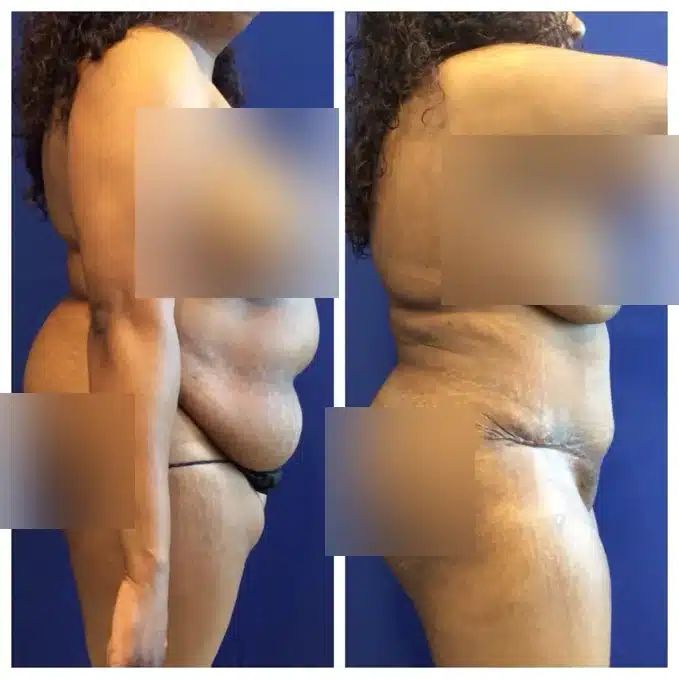
More consented body-contouring results are in the body contouring gallery.
Am I a Candidate for a Modern Tummy Tuck?
Every patient in the published protocol began with a comprehensive body examination — evaluating excess abdominal fat, a hanging pannus, stretch marks, skin inelasticity, weak or separated abdominal muscles (rectus diastasis), umbilical or abdominal hernias, prior scars, and mons pubis fullness.
You may be a strong candidate if you have loose abdominal skin and muscle separation after pregnancy or weight changes, are close to a stable healthy weight, and don’t smoke. Patients significantly above their ideal weight are counseled on weight loss first, because body mass index is one of the strongest predictors of complication risk in this surgery: across the literature Dr. Troell reviewed, patients with a BMI under 25 had roughly a 3% risk of a minor complication and under 7% risk of a major one — climbing past 40% for both once BMI exceeds 40.
Prior abdominal scars, including C-section scars, did not increase the complication rate in the study population and do not automatically rule anyone out. If your excess skin is circumferential — wrapping around the flanks and back after major weight loss — the conversation may point instead to a body lift.
Not Sure Which Operation Your Abdomen Actually Needs?
A consultation with Dr. Troell maps it out honestly — tummy tuck, liposuction alone, or no surgery at all. Free consultations for patients throughout Las Vegas, Summerlin and Henderson.
What If My Excess Skin Is Mild? The Surgery-Sparing Path
Not everyone bothered by their midsection needs a full tummy tuck. In Dr. Troell’s protocol, patients with only mild excess abdominal skin are offered a different path: third-generation VASER ultrasound liposuction alone, or combined with helium-plasma (Renuvion) skin tightening, instead of surgical abdominoplasty.
The pairing works because VASER already encourages skin tightening as it removes fat, and Renuvion’s helium plasma energy adds a second, targeted layer of tightening beneath the skin. Dr. Troell has published separately on combining these two technologies. For appropriately selected patients the combination can produce a smooth, firm abdominal contour without a tummy tuck’s longer scar and recovery.
It is not a substitute for surgery in every patient: a significant hanging pannus or a wide muscle separation still needs the structural repair only lipoabdominoplasty provides. Sorting out which side of that line you fall on is precisely what the examination is for.
What Happens During Surgery — and Why Most Patients Skip the Drain
After liposuction sculpts the abdomen, flanks and lower back, the excess skin and fat is precisely marked and removed. The separated muscles are repaired down the midline. The belly button is not simply reattached — it is rebuilt: creating a natural-looking neo-umbilicus is one of the most technically demanding parts of the operation, and the protocol uses a specific suspension-suture technique to give it a natural, unstretched appearance.
Because the modified technique avoids extensive undermining, very little empty space is left under the skin for fluid to collect — and the intact tissue keeps its blood and lymphatic circulation, so the fluid that does form has somewhere to go. The separated muscles are repaired with suture plication down the midline, an internal corset that restores the abdominal wall’s integrity. Most patients in the study did not need a surgical drain at all. Drains were reserved for patients with more than about 1.5 liters of fat removed from the abdomen or a higher BMI, where the added precaution lowers seroma risk.
What Are the Risks — Really?
No surgery is without risk, and published data beats a sales pitch. In the 50-patient series, the most common complication by far was seroma — a fluid collection under the skin — in 8 patients total, treated simply with in-office needle drainage and compression.
More serious but rare: vascular compromise along the incision in 2 patients, both with identifiable risk factors (one after massive bariatric weight loss with a very large skin excision; one with a BMI of 40 and an especially thick abdominal flap). Both healed with focused wound care — and those two patients were the only ones in the study not satisfied with their outcome. No patient in either group experienced a hematoma, a blood clot, pneumonia, or any anesthesia-related complication.
That record reflects a layered safety protocol: pre-operative bloodwork and cardiac clearance, blood-thinner precautions, compression devices during and after surgery, walking every two hours post-operatively, and careful airway monitoring given the higher rate of sleep apnea in this patient population — a subject Dr. Troell knows from the inside, having practiced sleep medicine at Stanford before dedicating his career to aesthetic surgery.
How the series compares with the published literature
| Measure | Dr. Troell’s 50-patient series | Published literature (as reviewed in the paper) |
|---|---|---|
| Seroma (fluid buildup) | 16% (8 of 50) — all resolved with in-office drainage | 10–57% reported incidence, highest in patients with obesity |
| Hematoma, blood clot, pneumonia, anesthesia complication | 0 patients | Severe complications of ~1 in 617 to 1 in 2,320 in older combined-technique series |
| Abdominal wall skin compromise | 2 patients, both high-risk, both healed with wound care | Historically over 5% with traditional undermining |
| Patient satisfaction | 96% (48 of 50) | — |
Every figure in that table comes from the same peer-reviewed paper — the comparison ranges are the published literature the study itself reviewed, not marketing numbers.
Results and Recovery: The Structured Timeline
Across the full study, 96% of patients were satisfied with their surgical outcome. Recovery follows a structured plan rather than guesswork:
- Month 1: compression garment and abdominal binder worn throughout; gentle walking from day one.
- Months 1–2: gentle manual massage to the treated areas.
- Follow-up visits at 1, 2, 4 and 6 weeks, then 2, 3, 6 and 12 months.
- About month 6: final healing — swelling resolved, skin fully settled and tightened.
For select patients wanting extra tightening, Renuvion helium-plasma treatment can be added immediately after the liposuction step — in Dr. Troell’s experience this did not increase the complication rate and added benefit in the upper abdomen, the hardest zone to tighten fully. Non-surgical radiofrequency or ultrasound tightening can also be layered in from about 10 days to 3 weeks after surgery. If you’re weighing this operation against its most common companion question, our guide to tummy tuck with lipo 360 covers how the circumferential version comes together.
Tummy Tuck Follow-Ups in Spanish
Dr. Troell speaks Spanish. The tummy tuck consultation at Troell Cosmetic Surgery in Las Vegas and the follow-up visits above are available in Spanish with Dr. Robert J. Troell; the practice has a Spanish-language patient coordinator, and the tummy tuck page is published in Spanish at drtroell.com/es/. Who speaks Spanish at each visit is worth asking any practice.
Modern Tummy Tuck FAQs
Will I need a drain after a modern tummy tuck?
Most patients in Dr. Troell's published protocol did not require one, thanks to the reduced undermining of the modified technique. A drain may still be recommended with larger fat-removal volumes (over about 1.5 liters from the abdomen) or a higher BMI, purely as an added safety measure.
How is lipoabdominoplasty different from liposuction alone?
Liposuction removes fat but cannot tighten loose skin or repair separated abdominal muscles. If you have significant excess skin or a noticeable muscle separation — common after pregnancy — liposuction alone will not fully address it. Lipoabdominoplasty combines fat removal, skin removal and muscle repair in one coordinated operation.
Can a tummy tuck fix ab separation from pregnancy?
Yes. Rectus diastasis repair — sewing the separated abdominal muscles back together along the midline — is a core part of the technique and was performed in essentially all patients in the study, with separations measuring up to 10 cm before repair.
Do C-section or other abdominal scars rule me out?
In the study population, prior abdominal scars did not increase the complication rate and did not exclude anyone from the modified technique. Your specific scar and its location are evaluated at consultation.
Which liposuction technology is better — ultrasound or power-assisted?
Both delivered strong results with low complication rates in the published comparison. Ultrasound (VASER) showed an edge in sculpting definition, skin tightening and bruising. Which fits your anatomy and goals is decided at consultation.
Can I skip surgery and just do VASER with Renuvion?
If your main concern is mild skin laxity rather than a hanging pannus or muscle separation, possibly yes — the protocol specifically offers VASER liposuction with Renuvion skin tightening as an alternative for appropriately selected patients. Whether you fit that group versus needing full lipoabdominoplasty is a key question the examination answers.
My mother only speaks Spanish. After her tummy tuck, will she talk to Dr. Troell herself at every follow-up, or will I be translating?
A fair thing to settle before you book, because a lipoabdominoplasty asks more of the patient afterward than most operations: the compression garment and abdominal binder through the first month, the gentle massage in months one and two, and eight follow-up visits spread across the first year, each one a chance to ask whether a soft, tender swelling is the seroma described above. Dr. Robert J. Troell speaks Spanish, so the consultation at Troell Cosmetic Surgery in Las Vegas, where he examines the hanging apron, the stretched skin, the muscle separation and any hernia or old scar and decides whether your mother needs the full operation or the surgery-sparing VASER and Renuvion path, happens directly between your mother and the surgeon who would perform it, not through you. The same is true at those follow-up visits, where the surgeon checks how her swelling, her incision and her skin are settling. The practice also has a Spanish-language patient coordinator for scheduling and for the pre- and post-operative questions that come up between visits, and the tummy tuck page is published in Spanish as Abdominoplastia en Las Vegas. What that means for you: how many hours a day the binder stays on, whether a fluid collection needs to be seen, and when walking can become more are questions she can ask and have answered in Spanish, by the people doing the work.
The Research Behind This Guide
This article is drawn from Dr. Troell's own published, peer-reviewed clinical research. The full list is maintained on the medical publications page.
- Troell RJ. Lipoabdominoplasty: Comparing Ultrasound-Assisted and Power-Assisted Techniques. Am J Cosmet Surg. 2023;40(4):279–292. doi:10.1177/07488068221099153
- Troell RJ, Javaheri S. Combining Third-Generation Ultrasound Liposuction With Helium-Based Plasma Technology Skin Tightening in the Face and Neck. Am J Cosmet Surg. 2025;43(2):170–177. doi:10.1177/07488068251330030
- Troell RJ. Breast Augmentation in Body Contouring Using Autologous Stem Cell-Enriched Fat Grafting: Fifteen-Year Clinical Experience. J Clin Med. 2025;14(16):5607. doi:10.3390/jcm14165607. PMID: 40869433
- Standards and Trends in Lipoabdominoplasty. Plast Reconstr Surg Glob Open. 2020;8(10). journals.lww.com — the field-wide review that places the blood-supply-preserving approach described above within the published mainstream.
This article is for general educational purposes and does not constitute medical advice. Individual results vary. Every surgical procedure carries risks, which should be discussed in detail during an in-person consultation with a qualified surgeon. Outcomes referenced reflect Dr. Troell's published, peer-reviewed clinical data and are not a guarantee of individual results.

Begin Your Journey with Dr. Troell
Schedule a complimentary consultation with Dr. Troell to discuss your goals, explore your options, and receive an honest, expert assessment. No obligation, no pressure.
Mon–Fri, 8:30 AM – 5:00 PM