
Body Contouring After Major Weight Loss: Your Options After GLP-1 / Ozempic
Published June 17, 2026 · By Dr. Robert J. Troell, Board-Certified Facial Plastic Surgeon
Dr. Robert J. Troell, MD, FACS

The short answer: After major weight loss — including the dramatic losses now common with GLP-1 medications like Ozempic, Wegovy, Mounjaro, and Zepbound — the fat is gone but the stretched skin usually stays. Loose, deflated skin does not reliably tighten on its own, and liposuction alone removes fat, not skin. The definitive treatment is excisional body contouring: surgically removing the excess skin and re-draping what remains, often combined with targeted liposuction and, where weight loss has hollowed an area, fat grafting to restore volume. The right plan depends on which areas bother you most, your skin quality, and whether your weight has stabilized. Facial volume loss from these same medications — "Ozempic face" — is covered in our Ozempic face guide.
Why major weight loss leaves loose skin
Skin is elastic, but it has limits. When the body carries excess weight for years, the skin stretches to accommodate it. After a large, relatively rapid weight loss, the underlying fat shrinks faster than the skin can recoil — and beyond a certain degree of stretch, the elastic fibers in the skin are permanently changed. The result is redundant, hanging skin most often seen at the abdomen, flanks and lower back, upper arms, inner thighs, breasts, and under the chin.
This is the rule, not the exception. In a 590-patient study of people after major weight loss, 62% wanted body-contouring surgery to address the excess skin (Plastic and Reconstructive Surgery 2019;143(5):1353–1360).

This is true whatever the route to weight loss — bariatric surgery, lifestyle change, or the newer GLP-1 medications (semaglutide and tirzepatide). What is new in 2026 is the sheer number of patients reaching a healthy weight quickly and then discovering that loose skin, not fat, is now their main concern. The medications solve the metabolic problem; they cannot retract skin. That is a surgical question.
Two factors predict how much skin will need to be addressed: how much weight was lost, and the starting quality of the skin (age, sun history, genetics, prior pregnancies, and how long the weight was carried). A consultation that honestly assesses skin elasticity is the foundation of a good result — and the reason an in-person evaluation matters more here than in almost any other area of cosmetic surgery.
Are you ready yet? Why weight stability comes first
The single most important question before contouring is whether your weight has stabilized. Operating before the weight has settled risks doing the surgery on a moving target — further loss after a skin excision can leave new laxity, and weight regain can stress fresh incisions. As a general rule, surgeons look for a weight that has held steady for several months and a nutritional status that supports healing.
This timing question is more nuanced for patients still taking a GLP-1 medication. Some are at a stable maintenance dose and a stable weight — good candidates. Others are still actively losing. There are also peri-operative medication considerations that your surgeon and prescribing physician should coordinate. None of this is a reason to wait indefinitely; it is a reason to plan the timing deliberately rather than rush. Good candidacy is less about a number on a scale and more about stability, health, realistic expectations, and skin that has finished changing.
The procedures, by body area
Post-weight-loss contouring is rarely one operation — it is a menu matched to where the excess skin actually is. The most common areas:
Abdomen. The most frequently requested area. A tummy tuck (abdominoplasty) removes the apron of lower-abdominal skin and tightens the muscle wall; when the excess is mostly skin from massive loss, the excision pattern is extended. For the abdomen specifically, our guide on the 360 tummy tuck with circumferential liposuction walks through how the front, flanks, and back are addressed together.
Flanks, back, and the “circumferential” roll. Major weight loss often leaves a belt of loose tissue all the way around the trunk. Treating only the front can leave the sides looking untreated, which is why a circumferential (belt) approach — combining excision with liposuction — is often planned.
Upper arms. Hanging upper-arm skin is one of the most common post-weight-loss complaints. The corrective procedure is an arm lift (brachioplasty), which trades the loose skin for a fine scar along the inner arm. Arm lift is covered, with the rest of the post-weight-loss operations, on the practice’s body lift after weight loss page.

Inner thighs. Similar story: a thigh lift trades loose inner-thigh skin for a concealed scar. Like arm lift, it is planned individually and discussed at consultation.
Breasts and chest. Weight loss frequently deflates the breasts and drops the nipple position. Restoring shape may involve a lift, an implant, fat transfer, or a combination — see breast augmentation and our piece on natural breast enhancement with fat grafting. For men, significant chest changes after weight loss may overlap with gynecomastia correction.
Buttocks. The buttocks often flatten and sag after major loss. A fat-grafting buttock procedure can restore projection using your own tissue.
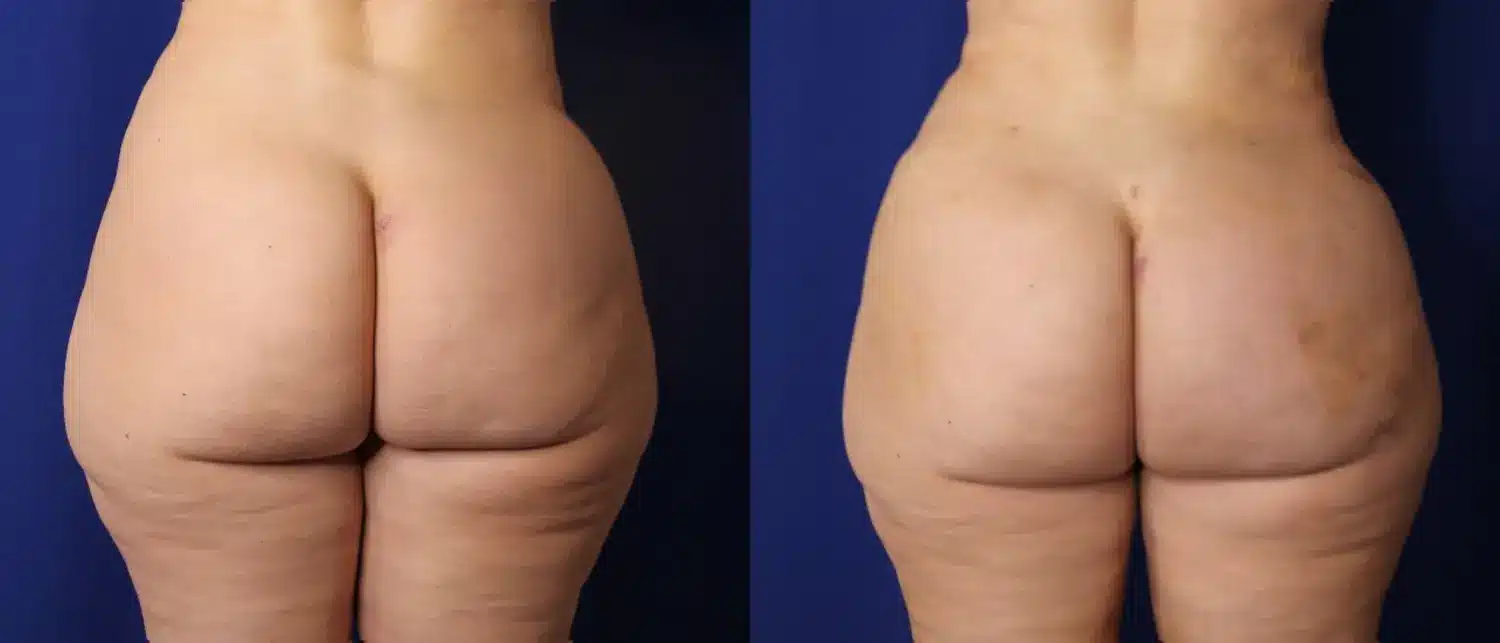
Many patients combine several of these into a staged plan — conceptually similar to a mommy makeover, but built around skin redundancy rather than post-pregnancy changes.
Body contouring by area, at a glance
| Body area | Common issue after major weight loss | Typical procedure | Main trade-off |
|---|---|---|---|
| Abdomen | Hanging lower-abdominal skin apron | Tummy tuck (abdominoplasty), extended if needed | A concealed lower-abdominal scar |
| Flanks & back | Circumferential roll of loose tissue | Belt lipectomy + liposuction | A longer, circumferential scar |
| Upper arms | Hanging upper-arm skin | Arm lift (brachioplasty) | A fine scar along the inner arm |
| Inner thighs | Loose inner-thigh skin | Thigh lift | A concealed inner-thigh scar |
| Breasts & chest | Deflation and drooping | Lift, implant, and/or fat transfer | Depends on the approach chosen |
| Buttocks | Flattening and sagging | Fat-grafting buttock restoration | Uses your own tissue; needs donor fat |
This is a starting map, not a prescription — which areas to treat, and in what order, is decided with your surgeon around what bothers you most and what is safe to combine.
Liposuction’s role after weight loss — and its limits
Liposuction is a powerful tool in post-weight-loss contouring, but it is widely misunderstood. Liposuction removes fat; it does not remove or tighten skin. In a patient whose skin still has good elasticity, removing residual fat pockets can refine the contour beautifully. In a patient with poor elasticity after a large loss, liposuction alone can actually unmask or worsen the looseness — which is why it is so often paired with, not substituted for, skin excision. The same logic governs the neck: for the patient whose jawline fullness is gone but whose skin is only mildly to moderately loose, Dr. Troell’s published technique pairs VASER with Renuvion skin tightening for the jawline and neck; a true fold of redundant neck skin remains a neck-lift problem.
Choosing correctly between “liposuction alone,” “excision alone,” and “both” is precisely the judgment that separates a natural result from a disappointing one. Dr. Troell’s two-part 2025 review of two decades of liposuction practice — Liposuction 20-Year Learned Experience, Part 1 (physician qualifications and preoperative risk assessment) and Part 2 (optimizing cosmetic outcomes while minimizing complications), both in the American Journal of Cosmetic Surgery (2025) — is built around exactly this question of patient selection and matching the technique to the tissue. Technologies like VASER ultrasound-assisted liposuction can help with denser or fibrous areas; for what a liposuction-based contour typically costs, see our VASER Lipo 360 cost guide.
Restoring volume where weight loss deflated it
Not every post-weight-loss concern is excess — sometimes it is the opposite. Faces, breasts, and buttocks frequently look deflated after a large loss, having lost the soft-tissue volume that gave them shape. Removing skin tightens; it does not restore fullness. That is where fat grafting comes in: liposuctioning fat from an area of excess and re-injecting it, purified, where volume is wanted.
This is a long-standing part of Dr. Troell’s practice. His fifteen-year clinical series on autologous stem cell-enriched fat grafting for breast enhancement — Breast Augmentation in Body Contouring Using Autologous Stem Cell-Enriched Fat Grafting: Fifteen-Year Clinical Experience, Journal of Clinical Medicine 2025;14(16):5607 (DOI 10.3390/jcm14165607) — followed 118 patients and reported 75–85% long-term volume retention, 95.8% patient satisfaction, and zero oil cysts. It documents using a patient’s own fat to restore shape, a particularly fitting approach after weight loss because the source fat and the recipient are the same person. The same principle applies to facial volume loss (the “Ozempic face” that drives many patients to ask about long-term midface volume options) and to buttock restoration.

One operation or several? How multi-area contouring is staged
Most post-weight-loss patients have more than one area to address, which raises a practical question: can it all be done at once? Sometimes related areas are combined in a single operation — the abdomen and flanks together, for example. But there are real limits on how much surgery is safe in one sitting, set by total operating time, blood loss, the body surface area being treated, and how the combination affects healing.
For that reason, comprehensive post-weight-loss contouring is frequently planned in stages spaced over months — prioritizing the area that bothers you most first, allowing full recovery, then addressing the next. A deliberate staging plan is safer and usually produces better results than trying to do everything in one marathon procedure. This sequencing is part of what you and your surgeon decide together at consultation, weighing your goals, your recovery capacity, and your budget.
Safety after major weight loss: healing, nutrition, expectations
Patients who have lost a great deal of weight are a distinct surgical population, and a careful surgeon treats them as one. Nutritional status matters: adequate protein and the absence of vitamin or mineral deficiencies (which can follow both bariatric surgery and very low intake on appetite-suppressing medications) support wound healing. A thorough preoperative assessment — the focus of the first part of Dr. Troell’s 2025 liposuction review — screens for the medical factors that affect safety before any contouring is scheduled.
Two honest expectations are worth setting now. First, excisional contouring trades loose skin for a scar; the scars are placed to be concealed by clothing and fade over time, but they are permanent, and a willingness to accept them in exchange for a better contour is part of being a good candidate. Second, results are individual — skin quality, the amount of loss, and healing all vary, so realistic, personalized expectations set at consultation matter more than any before-and-after photo of someone else.
Why surgeon experience and credentials matter here
Post-weight-loss contouring concentrates exactly the skills that distinguish an experienced surgeon: judging skin elasticity, choosing between excision and liposuction (and when to combine them), planning multi-area staging safely, and managing the healing of a patient whose tissues and nutrition are not those of an average cosmetic patient. It rewards experience and punishes shortcuts.
Dr. Robert J. Troell, MD, FACS brings more than 30 years of experience — as a Diplomate of the American Board of Cosmetic Surgery, among additional cosmetic and facial surgery boards — to this work, operating in an accredited surgical facility in Las Vegas, with two decades of liposuction and body-contouring practice formally reviewed in his 2025 publications. For patients — local to Las Vegas or traveling in for treatment — coming to body contouring after a major weight-loss journey, that combination of documented experience and a conservative, safety-first philosophy is the point.
Evidence & publications
The principles in this article draw on Dr. Troell’s peer-reviewed work in liposuction, body contouring, and fat grafting:
- Troell RJ. Liposuction 20-Year Learned Experience (Part 1): Physician Qualifications, Preoperative Risk Assessment. The American Journal of Cosmetic Surgery. 2025.
- Troell RJ. Liposuction 20-Year Learned Experience (Part 2): Optimizing Cosmetic Outcomes While Minimizing Complications. The American Journal of Cosmetic Surgery. 2025.
- Troell RJ. Breast Augmentation in Body Contouring Using Autologous Stem Cell-Enriched Fat Grafting: Fifteen-Year Clinical Experience. The Journal of Clinical Medicine. 2025;14(16):5607. DOI 10.3390/jcm14165607. PMID 40869433.
- van der Beek ESJ, et al. Body Contouring Surgery after Massive Weight Loss: Excess Skin, Body Satisfaction, and Qualification for Reimbursement in a Dutch Post-Bariatric Surgery Population. Plastic and Reconstructive Surgery. 2019;143(5):1353–1360. DOI 10.1097/PRS.0000000000005525. PMID 30789477.
General body-contouring guidance is consistent with the American Society of Plastic Surgeons (plasticsurgery.org). This article is educational and does not replace an in-person consultation and individualized assessment.
Common questions about body contouring after weight loss
Will my loose skin tighten on its own if I wait?
To a small degree, skin can recoil in the months after weight stabilizes, especially in younger patients with good elasticity and a more modest loss. But after a large loss, the skin’s elastic fibers are usually stretched beyond recovery, and the redundant skin will not retract to a normal contour. Surgical removal is the definitive treatment. Waiting long enough for your weight to stabilize is wise; waiting indefinitely in hope of spontaneous tightening usually is not.
Can liposuction alone fix loose skin after weight loss?
No. Liposuction removes fat, not skin, and it does not tighten skin. In a patient with poor skin elasticity after major weight loss, liposuction alone can make looseness more obvious. It is valuable when combined with skin excision, or on its own when skin quality is still good. Matching the technique to your tissue is the central judgment, and a frank assessment of your skin at consultation is what determines the right approach.
I lost weight on Ozempic or Wegovy — is that different from other weight loss?
For the skin, the principles are the same: a large loss leaves excess, stretched skin regardless of how the weight came off. What is worth coordinating is timing and peri-operative medication management if you are still on a GLP-1 medication, and attention to nutrition, since appetite suppression can reduce protein and micronutrient intake that healing depends on. These are planning considerations, not barriers.
How long should I wait after reaching my goal weight?
Surgeons generally want to see a weight that has held steady for several months before excisional contouring, so the surgery is done on a stable foundation rather than a moving target. The exact timing is individual and depends on your health, nutrition, and whether you are still losing. This is one of the first things assessed at consultation.
Can everything be done in one operation?
Sometimes related areas are combined, but there are safety limits on total operating time, blood loss, and treated surface area in a single session. Comprehensive multi-area contouring is often staged over months — addressing the highest-priority area first, recovering fully, then the next. A deliberate staging plan is both safer and usually better-looking than one marathon procedure.
Will I have scars?
Yes — excisional procedures trade loose skin for a scar. Scars are positioned to be hidden by clothing and typically fade substantially over the first year, but they are permanent. Accepting a well-placed scar in exchange for a better contour is part of being a good candidate for post-weight-loss surgery.
My face and breasts look deflated, not just loose. Can that be addressed?
Yes. Volume loss is the flip side of weight loss, and it is treated by restoring fullness rather than removing skin — commonly with fat grafting, which uses your own fat. It applies to the face, the breasts, and the buttocks, and is often combined with skin-tightening procedures for a balanced result.
How much does body contouring after weight loss cost?
Cost depends entirely on which areas are treated and how the plan is staged, so it is quoted after an in-person consultation rather than from a flat price list. As a starting point for one common component, our VASER Lipo 360 cost guide breaks down liposuction-based contouring pricing. A consultation produces a written quote with all costs disclosed and financing options.

Begin Your Journey with Dr. Troell
Schedule a complimentary consultation with Dr. Troell to discuss your goals, explore your options, and receive an honest, expert assessment. No obligation, no pressure.
Mon–Fri, 8:30 AM – 5:00 PM