
What a Natural Buttock Fat Grafting Result Looks Like — and How Long It Takes
Published June 11, 2026 · By Dr. Robert J. Troell, Board-Certified Facial Plastic Surgeon
Dr. Robert J. Troell, MD, FACS

The short answer: A natural buttock fat grafting (Brazilian Butt Lift) result is about proportion, not size — fuller through the upper curve, smooth from the side, and balanced with your waist and hips, so it reads as your own body. Roughly 240 cc of enriched fat is grafted per side; the shape settles over about three months as swelling resolves and some fat reabsorbs, and the surviving fat is a long-term result. Below: how to read a real before-and-after honestly, how the shape is planned for your frame, and the timeline.
The word that does the most work in a buttock fat grafting consultation is natural. Most patients are not asking to be dramatically larger — they are asking to look proportionate from the side, fuller through the upper curve, and smoother along the frame, in a way that reads as their own body rather than a procedure. This article is about what that result actually looks like, how the shape is planned to fit your frame, and how long it takes to settle — using a real case treated by Dr. Robert J. Troell at our Las Vegas practice.
What this article covers: what “natural” actually means in buttock fat grafting · how to read a real before-and-after honestly · how the shape is planned for your frame · the timeline from surgery to final result · what makes a result last · FAQ.
What a “Natural” Result Actually Means
A natural result from buttock fat grafting — the fat-transfer procedure behind a Brazilian Butt Lift — is defined by proportion, not volume. The eye reads a result as natural when the buttock is in balance with the waist and hips, when the projection from the side follows a smooth curve rather than a shelf, and when the outline along the outer hip and thigh is continuous. A result reads as “done” when those proportions are pushed past what the frame can carry — too much projection for the waist, or a sharp transition the skin was never going to hold.
This is why the most important number in the procedure is not how many cc’s are injected. It is how much the surrounding frame is shaped. Removing fat from the lower back and flanks narrows the waist and exposes the upper curve of the buttock; adding fat builds the projection. The result patients describe as natural is usually the product of both halves — subtraction and addition — planned as one silhouette. The mechanics of designing that frame, including the hip dips, are covered in depth in the companion article on the gluteal frame and hip dips.
How to Read a Before-and-After Honestly
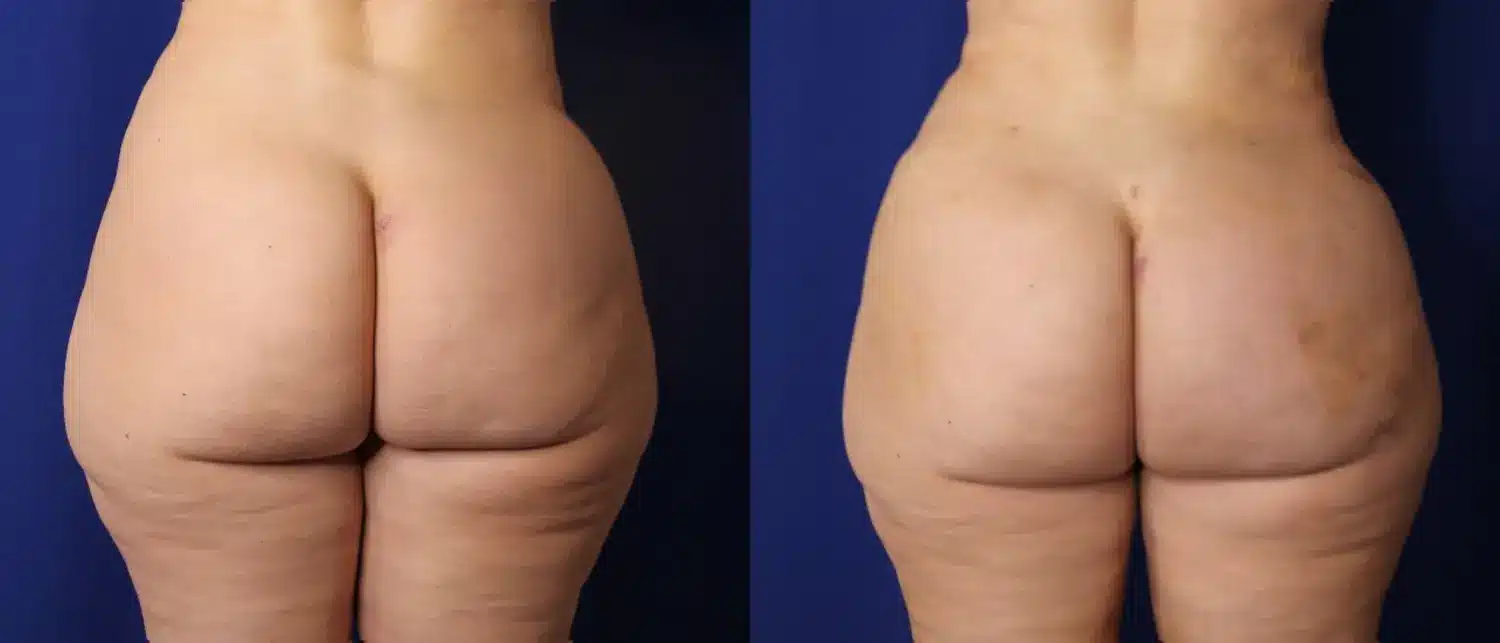
In the case above, the changes are the ones a proportionate result is built from: more fullness through the upper curve, smoother projection from the side, a softer transition at the outer hip where a dip had been, and a more continuous frame overall. What it is not is an extreme size change — the goal was a balanced silhouette for this patient’s frame, not the maximum volume the donor sites could yield.
Two honest caveats belong with any before-and-after photo. First, the “after” here is an early result — some bruising is still resolving, and a portion of the grafted fat will reabsorb before the contour finalizes. The shape you see at three months is the one that lasts, and it is slightly more refined than an early photo. Second, this is one patient’s outcome. What is achievable for any individual depends on their starting frame, skin quality, and how much donor fat is available — which is what a consultation assesses, with photographs and morphing, rather than promising a shape from someone else’s photo.
From Surgery to Final Shape
The result in any fat grafting before-and-after is a moment on a curve, so it helps to know the curve:
- First 1–2 weeks. Swelling and bruising are at their peak. Patients are asked not to sit directly against a chair back — to avoid compressing the grafted fat — and to sleep on the stomach or sides. The contour looks fuller than the final result will be, because of swelling.
- Weeks 2–8. Swelling resolves and the share of grafted fat that did not establish a blood supply is reabsorbed. The volume settles downward toward the true result. Compression is worn over the liposuction donor areas.
- ~3 months. A reliable picture of the final shape is usually visible. Fat that survives past this point behaves like the rest of your body fat and tends to remain stable for years.
This is why an early “after” photo, like the one above, is read with the timeline in mind: it shows the direction of the change honestly while the final refinement is still arriving. In the fat-grafting evidence and Dr. Troell’s clinical experience, roughly 75–85% of the grafted volume is retained at around seven months, and fat that survives past the first two to three months — once it has established its own blood supply — tends to remain stable for years; Dr. Troell has followed a patient with a maintained result at eight years. What helps a higher share of fat survive — careful processing, enrichment, and subcutaneous-only placement — and the safety profile behind it are covered in the companion article on awake, subcutaneous-only fat grafting safety.
Why a Published, Fat-Transfer–Certified Surgeon
Buttock fat grafting is one of the most technique-dependent procedures in aesthetic surgery: the difference between a natural, durable result and a disappointing or unsafe one is almost entirely the surgeon’s method and judgment. Dr. Robert J. Troell, MD, FACS brings a specific, published record to it:
- A Diplomate of the American Board of Cosmetic Surgery, with a fat-transfer subspecialty board. He earned the ABCS certification with the Robert F. Jackson Award for the highest score on the oral examination, and is also a Diplomate of the American Board of Stem Cell and Fat Transfer Physicians, the board specific to the fat-grafting techniques this procedure depends on.
- He published the outcome data behind his own protocol. His 2026 peer-reviewed study of 112 patients (Medical Research Archives) documents the technique, the grafted volumes (a mean of 240 cc per buttock), high patient satisfaction, and a complication profile with zero pulmonary fat emboli — alongside a 15-year stem cell–enriched fat grafting series and a 2022 paper on aesthetic hip implants in the Aesthetic Surgery Journal.
- He teaches the technique. A clinical instructor in ultrasound-assisted (VASER) liposuction and distinguished faculty for hands-on body-implant cadaver workshops, with Fellowship in the American College of Surgeons and more than 30 years in practice.
That published record is the difference between a surgeon who follows the body-contouring literature and one who contributes to it — and it is what backs the proportion-first, results-honest version of the consultation.

Natural Buttock Fat Grafting Results: Common Questions
What does a natural buttock fat grafting result look like?
A natural result is balanced with the waist and hips, projects smoothly from the side rather than as a shelf, and has a continuous outline along the outer hip and thigh. It reads as the patient’s own body rather than a procedure. Achieving it depends as much on shaping the surrounding frame — narrowing the waist and flanks, softening the hip dips — as on the volume added to the buttock itself. The aim is proportion for your frame, not the maximum volume the donor sites can yield.
How long until I see my final result?
Swelling and bruising peak in the first one to two weeks, then resolve over the following weeks as some of the grafted fat reabsorbs. A reliable picture of the final shape is usually visible around three months, and fat that survives past that point tends to remain stable for years. An early post-operative photo looks fuller than the final result because of swelling, which is why before-and-after images are best read with the timeline in mind.
Will buttock fat grafting look fake or “done”?
It looks “done” when the proportions are pushed past what the frame can carry — too much projection for the waist, or a transition the skin cannot hold. It looks natural when the result is planned to the patient’s frame, which is the proportion-first approach Dr. Troell uses. A consultation shows you, with photographs and morphing, what is achievable and balanced for your anatomy rather than transferring a goal from someone else’s photo.
Does the transferred fat stay permanently?
Some of every fat graft is reabsorbed in the first weeks, before the surviving fat establishes a blood supply. In the fat-grafting evidence and Dr. Troell’s clinical experience, roughly 75 to 85 percent of the grafted volume is retained at around seven months, and fat that survives past two to three months tends to remain stable for years — Dr. Troell has followed a patient with a maintained result at eight years. Because grafted fat behaves like the rest of your body fat, significant weight changes can enlarge or reduce it, so a stable weight helps preserve the result.
How much bigger will I actually look?
That depends on how much donor fat is available and how much the subcutaneous space will safely accept — not on a target number. In the published series the average was about 240 cc of compacted, enriched fat per buttock, but the right volume is set by your frame and donor sites, and the goal is a proportionate silhouette rather than a maximum. Very lean patients may have limited donor fat and may be offered staging or alternative options at consultation.
Is buttock fat grafting safe?
Buttock fat grafting has historically been the most scrutinized procedure in aesthetic surgery because of one specific risk — pulmonary fat embolism, tied to fat injected deep into the gluteal muscle. Dr. Troell’s protocol places fat in the subcutaneous plane only, never the muscle, with the patient awake enough to give immediate feedback and intraoperative ultrasound confirming the plane; his 112-patient series reported no pulmonary fat emboli. The procedure still carries real risks, including seroma, contour irregularity, infection, and the possible need for revision. The safety mechanics are covered in full in the companion article on awake, subcutaneous-only fat grafting.
How much does buttock fat grafting cost in Las Vegas?
Cost depends on the number of liposuction donor areas, whether the hip dips and buttock are both grafted, and whether other steps are combined, so it is quoted after an in-person consultation rather than from a flat price list. Troell Cosmetic Surgery is a self-pay specialty practice; the consultation includes a written quote with all costs disclosed, and financing options through CareCredit and Alphaeon are available.
Individual results may vary. The before-and-after photograph is of an actual patient of Troell Cosmetic Surgery who provided consent for its use. It shows one person’s outcome at an early post-operative stage and is not a prediction or guarantee of any individual result.
Patient education. This article explains what a natural buttock fat grafting result looks like, how the shape is planned, and how long it takes to settle. It is not a substitute for an in-person consultation, an individualized risk assessment, or informed consent obtained directly from a treating surgeon.
- Last medically reviewed: 2026-06-10 by Robert J. Troell, MD, FACS
- Conflict-of-interest disclosure: This article describes a procedure performed at Troell Cosmetic Surgery & Facial Plastic Clinic and summarizes peer-reviewed research authored by Dr. Troell. The practice has a direct interest in patients considering the procedure described.

Begin Your Journey with Dr. Troell
Schedule a complimentary consultation with Dr. Troell to discuss your goals, explore your options, and receive an honest, expert assessment. No obligation, no pressure.
Mon–Fri, 8:30 AM – 5:00 PM